The short answer
The five leg machines that earn their footprint in a home gym are the pendulum squat, the hack squat / leg press, the leg extension / leg curl, and the belt squat — and most lifters should buy them in roughly that order. The pendulum squat is the all-around leg builder for people who want one machine to do most of their leg day. The hack squat / leg press combo is the high-load workhorse for serious quad development and the lifter who wants to keep loading after the squat rack stops feeling productive. The leg extension / leg curl machine is the only way to truly isolate the quads and hamstrings without a cable stack. The belt squat is the joint-friendly squat replacement that lets aging lifters keep training heavy without their knees, lower back, or shoulders paying the price. There's no single best — each machine solves a specific problem your barbell can't.
Prefer video? Here's the Pandemonium Squat — our 3-in-1 pendulum squat machine — walked through end-to-end:
Why leg machines belong in a serious home gym
For years the home gym answer to leg day was "just squat." Squat heavy, squat often, and you'd build a full lower body. That advice is fine right up until your knees, your lower back, or your shoulder mobility tells you it isn't. Then you're stuck — because a barbell back squat is one tool, and one tool can't fix a problem the tool itself created.
Leg machines exist for the same reason machines exist anywhere in a gym: they let you load a specific movement pattern with maximum stability and minimum demand on the rest of the body. A heavy back squat asks your spine to support the weight, your shoulders to hold the bar, your core to stay rigid, and your hips and knees to do the actual work. A hack squat asks your hips and knees to do the actual work. That difference matters when you're trying to build legs without burning down your central nervous system, when you're rehabbing an injury, or when you're 45 years old and want to keep training hard for another twenty years.
The five machines below cover the four jobs every well-built home gym leg day asks for:
- A heavy compound that isn't a barbell squat — for max-effort leg work without the spinal load. Pendulum squat, hack squat, leg press, belt squat.
- Quad isolation — for direct quad work that no compound lift fully replaces. Leg extension.
- Hamstring isolation — for direct hamstring work most home gyms skip entirely. Leg curl.
- Joint-friendly squatting — for the day your back, shoulders, or knees need a break but you still want to train hard. Belt squat.
This guide walks through each machine in detail — what it builds, who it's for, what the trade-offs are, and which Bells of Steel option fits each job. By the end you'll know which one to buy first, second, and which one to skip entirely.
The 5 leg machines at a glance
Here's the quick comparison. Use this as a decision matrix, then read the deep-dive on whichever machine you're closest to buying.
| Machine | Primary muscles | Best for | Footprint | Price tier |
|---|---|---|---|---|
| Pendulum Squat | Quads, glutes | All-around leg builder; one-machine leg day | Compact (tall, narrow) | $$ |
| Hack Squat / Leg Press | Quads (hack), full leg (press) | Heavy loading, quad mass, high-volume sets | Large (long sled) | $$$ |
| Leg Extension / Curl | Quads (ext), hamstrings (curl) | Isolation, hypertrophy, finishers | Medium | $$ |
| Belt Squat | Quads, glutes (no spinal load) | Joint-friendly squatting, aging lifters, high volume | Medium | $$ |
1. Pendulum Squat — the all-around leg builder

If you can only own one leg machine, the pendulum squat is the strongest single answer. It's a fixed-arc squat where the load travels along a curved path instead of straight up and down — which means the resistance changes through the lift in a way that matches how your body actually produces force. You feel it most where most lifters need it most: in the bottom half of the squat.
The pendulum squat hits the quads hard, lights up the glutes, and takes almost all of the load off your spine. There's no bar on your back, no shoulder mobility requirement, and no balance demand. You set up, you squat, you stand. That sounds simple, and it is — which is exactly the point.
What muscles does a pendulum squat work?
The pendulum squat is a quad-dominant movement, but the curved load path biases the bottom of the lift more than a hack squat does — which means you also get significant glute and adductor recruitment in the deep part of the rep. Hamstrings get involved as stabilizers but aren't the primary driver. Calves and core are essentially unloaded compared to a back squat, which is the whole point.
Why is the pendulum squat so hard?
Two reasons. First, the load path keeps tension on the quads through the entire rep — there's no point where the bar "hides" on your skeleton the way it does at the top of a back squat. Second, the curved path puts you deepest into the hardest part of the squat at the bottom of the rep, exactly where most lifters are weakest. That combination makes pendulum squats feel disproportionately hard for the load on the machine. Most lifters end up using less weight than they expect — and getting more out of it.
Who it's for
- The lifter who wants leg gains without spinal load. If your back is the limit on your squat, this is the machine that gets you back to training quads hard.
- The mobility-limited lifter. No barbell on the back means no shoulder, wrist, or thoracic mobility requirement.
- The home gym owner who wants one machine to do most of leg day. Pendulum squats can serve as your main quad lift, your accessory leg work, or both.
- The lifter over 40. Spinal load adds up. The pendulum squat lets you keep training quads heavy for years without that cost.
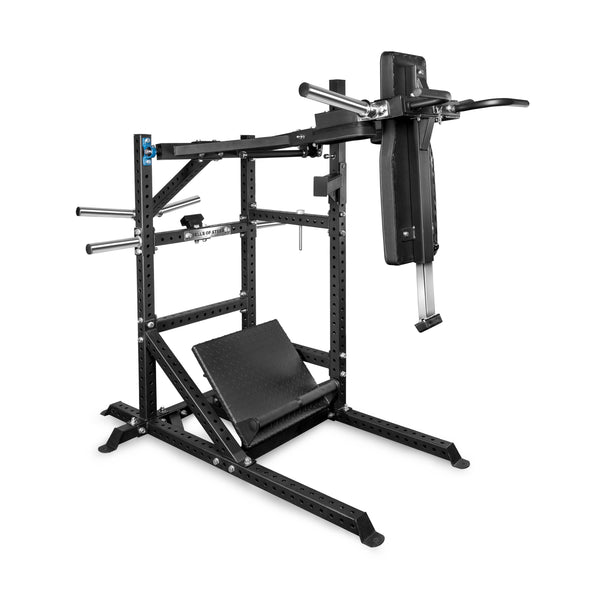
The Bells of Steel pick: Pandemonium Squat
The Pandemonium Squat is a 3-in-1 machine — pendulum squat, calf press, and Viking press in one piece of equipment. It uses three peg levels to accommodate lifters up to about 6'5", a removable back pad with magnetic pins, and a counterbalance arm that smooths out the resistance curve and reduces the "thud" you get with heavier sets. The single tall upright keeps the footprint surprisingly small for a machine that does this much.
One machine that delivers the best leg builder, a calf raise station, and a Viking press for shoulders is the kind of multi-job equipment that earns its place in a home gym fast. See the full spec sheet here.
2. Hack Squat / Leg Press — the high-load workhorse

If the pendulum squat is the all-arounder, the hack squat / leg press combo is the heavy artillery. Both movements run the load on a fixed sled, which means you can pile on weight without the balance and stability demands of a free squat. That's why commercial gyms use them for the strongest people in the building, and why they belong in any home gym serious about quad development.
The two movements complement each other. The hack squat keeps you relatively upright and bias the load toward the quads — it's the closest thing on a sled to a back squat, with all the central nervous system cost stripped out. The leg press flips you onto your back, drops the spinal load to zero, and lets you load truly heavy weights for high-volume work. Different angles, different stress, same machine.
How much does a hack squat machine weigh?
A serious plate-loaded hack squat / leg press combo machine weighs in the 400–600 lb range without plates loaded. Most quality home-gym machines fall around 500 lb of bare weight, with weight capacities — meaning the sled itself plus how much you can load on it — starting around 1,000 lb. The bare weight matters when you're planning a basement gym or a second-floor space; the weight capacity matters because if the machine caps at the same number you can already lift, you've outgrown it before you bought it.
How to use a hack squat machine
Set the sled height so the safeties (foot stops or pin stops) catch the sled at the depth you can hit cleanly. Set your foot position — higher on the platform biases the glutes and hamstrings, lower biases the quads. Load the plates evenly on each side. Position your shoulders under the pads, brace your core, unrack the safeties, and squat under control. Drive through the whole foot, not just the toes. Lock back the safeties before you step out — never trust the sled to hold weight while you're getting up.
Who it's for
- The quad-development specialist. Nothing else lets you load this heavy on a quad-biased movement.
- The high-volume hypertrophy lifter. Sets of 20 on a leg press are a different kind of misery than sets of 20 on a back squat — more productive, less destructive.
- The lifter who wants both options. A combo machine gives you two distinct training tools in one footprint.
- The lifter graduating from basic gear. If your barbell rack is already in place and you're looking for the next big upgrade, this is it.
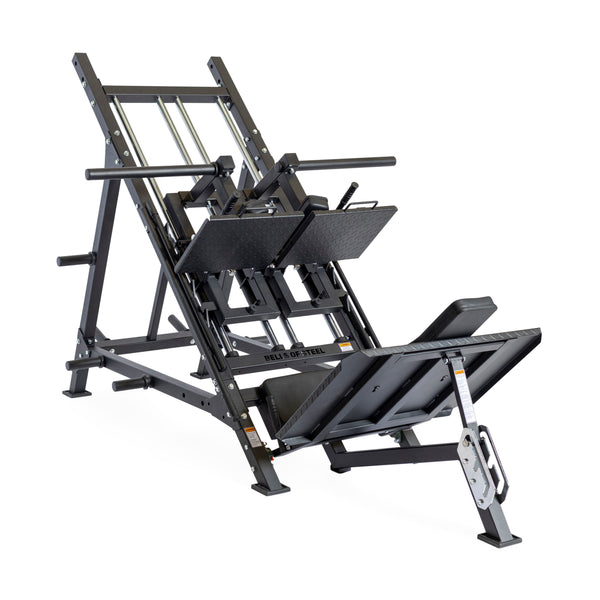
The Bells of Steel pick: Leg Press / Hack Squat Machine
The Leg Press Hack Squat Machine is a plate-loaded 2-in-1 with a 1,000 lb sled capacity, five racking positions for different lifter heights, and band pegs so you can add accommodating resistance at the top of the lift — a feature commercial gyms almost never offer. It's a current best-seller in our strength machine collection because the value-per-square-foot is hard to beat: two distinct movements, real loading capacity, and a footprint that fits in a real garage.
See it move:
3. Leg Extension / Leg Curl — the isolation specialist

Compound lifts build most of your leg, but they don't build all of it. The quads have a job — extend the knee — that no squat or press fully isolates, because hip extension always plays a supporting role. The same is true for the hamstrings, but in reverse: their primary function in a flexed-knee curl pattern doesn't get touched by deadlifts, RDLs, or any compound lift you can do with a barbell.
That's the gap a leg extension / leg curl machine fills. It isolates two movements no compound lift covers, and it lets you accumulate volume on those muscles without the central nervous system tax of another heavy compound. Skip this machine and you're leaving a clean 15–20% of your leg development on the table.
Why home gyms skip leg curls (and shouldn't)
Most home gyms get built around the squat rack and the bench. By the time the lifter realizes their hamstrings are underdeveloped, they're three years and several injuries in. The hamstring's two main functions — knee flexion and hip extension — only get half the attention they need from RDLs and good mornings alone. Curls finish the job. They're also the single best preventative for hamstring strains in any lifter who runs, jumps, or pulls heavy.
Who it's for
- The physique-focused lifter. If aesthetics matter, isolation work isn't optional.
- The strength athlete who wants joint health. Direct hamstring work prevents the imbalances that show up as knee pain over time.
- The lifter doing high-frequency leg work. Compound work two days a week, isolation on a third day, and your legs will outpace what squats alone can do.
- The home gym builder finishing their leg setup. Once the squat / press machine is in place, this is what completes leg day.
The Bells of Steel pick: Legacy Leg Extension / Hamstring Curl Machine
The Legacy Leg Extension / Hamstring Curl Machine is plate-loaded and uses a patent-pending toggle that delivers full range of motion with no dead zone — meaning your quad gets the deepest stretch it can take before the cam loses tension, and your hamstring works through the full curl with no slack at the bottom. It switches between leg extensions, prone hamstring curls, and seated hamstring curls so you get all three movements from one footprint. Five adjustment points, six seat angles, six back-pad angles, and double-thick rollers across the board.
This is the machine for lifters who care about their legs as much as they care about their bench, and who don't want to spend $3,000 on a commercial-grade selectorized stack to get there. See the full spec sheet here.
4. Belt Squat — the joint-friendly squat replacement

The belt squat is the leg machine for lifters who want to keep training hard for the rest of their life. Instead of a barbell on your back or a sled pressing down on your shoulders, the load hangs from a belt around your waist. The result is a heavy squat with zero spinal compression, zero shoulder strain, and almost none of the lower-back fatigue that catches up to lifters in their thirties and forties.
If your back has ever locked up after a heavy squat day, if your shoulders no longer let you sit a low-bar comfortably, if your knees are the limit on your training rather than your legs — the belt squat solves all of that. It's also one of the best high-volume tools in any home gym. Sets of 20 belt squats build legs without the central nervous system fatigue that makes you skip workouts later in the week.
How to use a belt squat machine
Step into the belt and adjust the height on the machine so the lift starts from your full standing position. Brace your core, sit into the squat, and stand back up. The belt pulls down on your hips, which means the load goes through your legs without ever touching your spine. You'll find you can squat to depth more easily than you can with a barbell on your back — the load path doesn't fight your hip angle.
Use the band pegs at the top of the machine to add accommodating resistance for lockout work. Use a wider stance if you want more glute and adductor involvement, narrower for quad bias. The belt squat is more versatile than its reputation suggests once you actually own one.
Is a belt squat better than a regular squat?
For some jobs, yes. For others, no. A belt squat is better than a back squat for high-volume work, for joint-friendly heavy training, for late-week leg sessions when your back is fried, and for anyone whose injury history makes a barbell on the spine a non-starter. A back squat is still better for whole-body strength development, for athletes whose sport requires bar-on-back loading, and for anyone with no joint issues and time to recover. Most lifters benefit from both — using the back squat as the primary lift and the belt squat as the high-volume accessory.
Who it's for
- The lifter over 40. Heavy spinal compression is the cost most aging lifters pay first. Belt squats let you skip that bill.
- The lifter with a back, shoulder, or knee issue. Most of the load problems people quit barbell squatting over disappear with a belt squat.
- The high-volume hypertrophy lifter. 5x20 belt squats are a different beast than 5x20 back squats — much more productive per recovery dollar.
- The garage gym owner who wants their legs to outlast their 50s. This is the longevity machine.
The Bells of Steel pick: Belt Squat Machine
The Belt Squat Machine has a 700 lb weight capacity, commercial-grade Zerk bearings for smooth load travel, four band pegs for accommodating resistance at lockout, and 13 adjustable heights so the machine actually fits your specific stance. The base footprint is 51" × 81", but a vertical plate-peg storage option shrinks it to 51" × 52.5" when you're not lifting — a real consideration for garage gyms where every square foot is fighting for space.
See it move:
Honorable mention: the Reverse Hammer (posterior chain machine)

Not a leg machine in the strictest sense, but worth mentioning because it solves a problem the four machines above don't: training the posterior chain — lower back, glutes, and hamstrings together — through their full range of motion. The Reverse Hammer combines a Glute Ham Developer (GHD) and a reverse back extension machine into one unit, so you get hamstring curls, glute-ham raises, and posterior-chain extension work from the same footprint.
If you've already got a leg press / hack squat for the front of the leg and you want a single piece of equipment that completes the posterior chain without buying a separate hyperextension bench, this is it. We're covering it in detail in a separate guide on posterior chain machines.
Which leg machine should you buy first?
The right buying order depends on what your home gym already has and what your training history looks like. Here's the framework we walk customers through in our showrooms:
If you only own a rack, bench, and barbell
Buy a hack squat / leg press first, or a pendulum squat first. Either gets you a heavy quad-builder that doesn't compete with your barbell squat — it complements it. The hack squat / leg press wins if you care about loading heavy and have the floor space. The pendulum squat wins if your space is tight or you want one machine to handle most of leg day.
If you already have a hack squat or pendulum squat
Buy a leg extension / leg curl next. Now you've got the compound covered. The isolation machine fills the two gaps no compound lift can: direct quad isolation and direct hamstring curls. This is the move that turns "I have a strong squat" into "I have strong, balanced legs."
If you're 40+ or fighting an injury
Buy a belt squat first or second. Aging lifters get pushed off barbell squats by their backs, shoulders, and knees long before their legs give out. The belt squat extends the runway for years. Pair it with a leg extension / curl as soon as budget allows and you've got a lower body program that scales into your fifties and sixties.
If you compete in physique sports
Stack the order: pendulum squat or hack squat first, leg extension / curl second, belt squat third for high-volume work. Physique training rewards volume and isolation more than it rewards heavy compound load. Build around that.
Common questions about home gym leg machines
Can I just do all of this with a barbell?
Some of it, yes. All of it, no. A barbell builds tremendous strength, but it can't isolate the quads (no leg extension equivalent), it can't isolate the hamstrings in flexed-knee patterns (no leg curl equivalent), and it can't load your legs without loading your spine (no belt squat equivalent). Home gym lifters who pretend otherwise tend to end up with strong squats and weak quads, big deadlifts and tweaky hamstrings, and a back that gives out long before their legs are done.
How much weight can a home gym leg machine hold?
Modern plate-loaded home machines start around 700 lb of weight capacity (for a belt squat) and go up to 1,000+ lb for a leg press / hack squat sled. That's enough loading headroom for nearly every recreational lifter on Earth. If you're a competitive powerlifter or strongman moving past those numbers, you're already buying commercial-grade equipment.
Are home leg machines as good as commercial gym machines?
The quality gap has closed dramatically in the last five years. Modern home-grade plate-loaded machines from companies that take their engineering seriously match commercial machines on weight capacity, frame integrity, and movement quality. The differences that remain are mostly in selectorized weight stacks (commercial gyms can run pin-select stacks; home gyms run plate-loaded), upholstery durability under 12-hour-a-day use, and aesthetic finish — none of which affect how the machine actually trains your legs.
How much space do I actually need?
A pendulum squat or belt squat fits in roughly 50 sq ft of floor with clearance around it. A leg extension / leg curl needs about 40 sq ft. A leg press / hack squat combo runs 80–100 sq ft because the sled is long. The full leg machine setup — pendulum + leg press + leg ext/curl + belt squat — fits in about 250 sq ft, which is the back half of a single-car garage. A two-car garage holds it all easily.
Do I need all four?
No. Most lifters end up with two: a heavy compound machine (pendulum or leg press / hack squat) and an isolation machine (leg ext / curl). That covers the major gaps a barbell can't fill. Aging lifters and high-volume trainees often add the belt squat as a third. Very few home gyms need all four, and even fewer need all four plus a Reverse Hammer — but if you're building a forever gym, the case is real.
The bottom line
The barbell will always be the foundation of a home gym — but it's a foundation, not a finished build. Leg machines fill the four jobs the bar can't: heavy loading without spinal compression, true quad isolation, true hamstring isolation, and joint-friendly squatting that keeps you training hard into your fifties and beyond.
If you're buying one machine: Pendulum squat or leg press / hack squat. Both make leg day better immediately.
If you're building a complete leg setup: add a leg extension / leg curl machine second. That's where compound work starts to plateau without isolation work to back it up.
If you're 40+ or training for the long run: the belt squat is non-negotiable. It's the machine that lets you keep going when everything else starts asking you to dial back.
Whatever you pick, pick something. Most home gyms hit a quad-development ceiling within two years of buying their rack — and the lifters who push through it are the ones who finally added a real leg machine to the floor.
Build your leg day at Bells of Steel
Every machine in this guide is built and shipped from our Calgary HQ — designed to live in a home gym, priced to make sense, and built to outlast the lifter who buys it.