The short answer
The Viking press is a heavy overhead press done with two parallel angled handles instead of a straight barbell, originally a strongman event and now one of the most shoulder-friendly ways to press heavy at home. The angled press path puts the shoulder in a more natural position than a strict overhead press, which means lifters with bad shoulders, mobility issues, or impingement history can keep pressing heavy without the joint cost. You can set one up at home with a dedicated Viking press station, a landmine attachment in a corner, or a 3-in-1 squat machine like the Pandemonium Squat that includes a Viking press station built in. For most home gym lifters, the 3-in-1 machine is the cleanest answer — one footprint, three movements, no garage corner sacrificed to a landmine.
Prefer video? Here is the Pandemonium Squat — our 3-in-1 machine with a built-in Viking press station — walked through end-to-end:
What is a Viking press?
The Viking press is an overhead press performed with two parallel angled handles that rotate around a fixed pivot point, usually at the bottom of a vertical post or against a wall. Instead of pressing a straight barbell from your shoulders to lockout, you grip two handles and press them up and slightly outward along a curved arc.
The exercise originated in strongman competitions, where it became a fixture as a more spectator-friendly alternative to the log press or axle clean and press. Over the past decade it has migrated into mainstream powerlifting, bodybuilding, and home gym training because of one specific quality: it lets lifters press heavy overhead without the shoulder mobility demand of a true strict press.
The result is a press variation that hits the shoulders, triceps, and upper chest the way a barbell overhead press does, but with a much friendlier path through the joint. Lifters who cannot hold a barbell overhead without pain can usually press a Viking press without issue. Lifters who can do both report better shoulder health when they make the Viking press their primary heavy press and use the barbell version for accessory work.
A short history of the Viking press
The Viking press first appeared as a strongman competition event in the early 2000s. The name comes from the apparatus itself, which was originally a heavy-duty steel implement designed for outdoor strongman events. Strongman competitors would press the apparatus for max reps in a fixed time window, typically loaded with somewhere between 200 and 400 pounds. The event rewarded pressing endurance and the ability to drive heavy weight overhead without the technical demands of a clean and jerk.
By the mid-2010s, scaled-down "gym version" Viking press attachments started appearing in commercial gyms and home gyms. Today, the Viking press is one of the most popular heavy press variations among lifters who want the benefits of overhead pressing without the joint cost. It also has a strong following among strongman-curious lifters who do not want to invest in a full strongman implement collection.
What muscles does a Viking press work?
The Viking press is a compound pressing movement that primarily targets the shoulders and triceps, with significant secondary involvement from the upper chest and core.
- Anterior deltoids (front delts): Primary mover. The angled press path keeps the front delts engaged from start to lockout.
- Lateral deltoids (side delts): Heavy secondary mover. The slight outward angle of the press path recruits the side delts more than a strict barbell overhead press.
- Triceps (long head especially): Primary lockout muscle. The overhead press path puts the long head of the triceps in a stretched position at the bottom and full contraction at the top.
- Upper chest (clavicular pectoral fibers): Significant secondary. The angled press path engages more upper chest than a vertical overhead press.
- Upper back, rear delts, and traps: Stabilizers. The two-handle grip requires more upper back tension than a barbell.
- Core, glutes, and quads: Bracing muscles. Standing Viking presses require full-body tension to drive heavy load overhead.
The pec involvement is what separates a Viking press from a strict overhead press. The slight outward angle of the press path engages more clavicular pectoral fibers than a barbell press, which is why the Viking press feels more like a "incline at angle" than a pure shoulder lift.
Why the Viking press belongs in a home gym
Five reasons most home gym lifters who try a Viking press end up keeping it as a permanent fixture:
1. It is the most shoulder-friendly heavy press in lifting
The barbell overhead press demands a lot from the shoulder joint — full external rotation at the bottom, perfect overhead mobility at the lockout, and a wrist position that aggravates a lot of older lifters. Many lifters reach a point where they cannot press a heavy barbell overhead anymore without paying for it the next day.
The Viking press solves all of that. The handles let your wrists stay in a neutral grip. The press path is at an angle, not perfectly vertical, so the shoulder is not asked to hit full overhead extension. The fixed arc means you are not stabilizing a free-floating bar — you can focus on pressing hard. For lifters with a history of shoulder impingement, AC joint issues, or rotator cuff problems, the Viking press is often the only heavy press that still feels good.
2. It loads heavy
Because the Viking press travels along a fixed path, you can load it heavier than a barbell overhead press. Most lifters Viking press 50 to 100 pounds more than they overhead press, which means more total stimulus on the shoulders and triceps. That is the same logic that makes hack squats outperform back squats for pure quad development — fixed path plus supportive structure equals more loading.
3. It is a strongman crossover for free
If you have ever wanted to dabble in strongman training — log press, axle clean and press, circus dumbbell — the Viking press is the closest you will get without buying actual strongman implements. The press pattern is similar enough that Viking press strength carries over to those events. Lifters who want to train for a local strongman competition can do most of their pressing prep on a Viking press station and a barbell.
4. It hits the upper chest and front delts together
The angled press path means the Viking press functions like a hybrid of an incline bench press and an overhead press. You get clavicular pec activation and front delt activation in the same lift. For lifters whose upper chest lags behind their lower chest (a near-universal physique problem), the Viking press is one of the highest-output exercises for closing that gap.
5. It scales for any lifter, any goal
Heavy triples, sets of 8, sets of 20, drop sets, rest-pause, mechanical drops — the Viking press tolerates all of them well because the fixed path keeps form intact even when fatigue accumulates. A barbell overhead press starts breaking down well before failure. A Viking press lets you push much closer to true muscular failure, which means more total productive volume per set.
Viking press vs overhead press: which one should you do?
Both, ideally. They train similar muscles in different ways, and lifters who use both as part of a long-term pressing rotation tend to have better shoulder development and better shoulder health than lifters who do only one.
| Factor | Viking Press | Barbell Overhead Press |
|---|---|---|
| Press path | Angled, fixed arc | Vertical, free |
| Shoulder demand | Lower (joint-friendly) | High (full mobility required) |
| Max load potential | Higher (50–100 lbs more typical) | Lower |
| Stabilizer demand | Lower (fixed path) | Higher (free bar) |
| Upper chest involvement | Significant | Minimal |
| Best for | Heavy loading, joint health, hypertrophy | Whole-body strength, athletic carryover |
The simple rule: if you can do both pain-free, alternate between them across mesocycles. If your shoulders no longer tolerate the barbell version, the Viking press becomes your primary heavy press without losing meaningful pressing strength.
How to do a Viking press: step-by-step form breakdown
Setup is simpler than a barbell overhead press, but the cues that make a Viking press most productive are easy to miss. Here is the step-by-step.
- Set your stance. Step into the machine so the handles are at the front of your shoulders at the starting position. Most lifters land in a hip-width stance, with feet flat on the floor. Strongman lifters often use a wider stance for stability under heavy loads.
- Grip the handles. Your grip should be neutral (palms facing each other) on most Viking press attachments. Wrap your thumbs around the handles. Keep your wrists stacked over your forearms, not bent back.
- Set your bottom position. The handles should be just outside or just in front of your shoulders. Elbows should be tucked at roughly a 45-degree angle, not flared out. Chest tall, ribs down, core tight.
- Brace your core. Take a big breath, brace your core like you are about to take a punch, and squeeze your glutes. This locks your torso and lets you transfer leg drive into the press.
- Drive up and slightly out. Press the handles up and slightly outward along the arc of the press path. Do not try to press straight up — that fights the machine.
- Lock out at the top. Full elbow extension. Triceps locked, shoulders shrugged slightly upward toward your ears at the very top of the rep.
- Control the descent. Lower the handles back to the start position under control. The eccentric is where most of the muscle damage happens, so do not let the load drop — lower it deliberately.
- Reset between reps. Take a fresh breath at the start of every rep. Do not chain reps without resetting your brace.
Common form mistakes
- Pressing straight up instead of along the arc. Fights the machine, reduces load capacity, increases shoulder strain.
- Flaring elbows to 90 degrees. Puts the shoulder in a vulnerable position. Keep elbows at 45 degrees from the torso.
- Losing core brace at the top of the rep. Causes hyperextension at the lower back. Stay braced throughout.
- Dropping the handles too fast on the descent. Loses 50% of the muscle-building potential of the lift.
- Not setting up tall enough. If your bottom position is too low, the press starts with the handles below your shoulders, which puts the front delt in a compromised position.
How to set up a Viking press at home
You have three real options for adding a Viking press to a home gym. Each has trade-offs in cost, footprint, and how authentic the press feels relative to the strongman original.
Option 1: A 3-in-1 squat machine with Viking press built in (best for most home gyms)
The cleanest setup. A purpose-built machine like the Pandemonium Squat includes a Viking press station as one of its three functions, so you get the press, a pendulum squat, and a calf press in one footprint. The Viking handles fold or mount on the same upright as the squat machine, which means you are not dedicating a separate corner of the gym to a press-only station.
This is the right answer for most home gyms because it solves the floor-space problem. A standalone Viking press station is a big piece of equipment that does one thing. A 3-in-1 machine does three. The Viking press station on the Pandemonium uses the same upright as the squat machine, which keeps the overall footprint manageable for a real garage gym.
Option 2: Landmine attachment in the corner (best for tight budgets)
The lo-fi setup. A landmine attachment anchors a barbell sleeve in a corner or to a rack, and you press the bar from your shoulder to overhead at an angle. It is not a true Viking press — you are holding a barbell instead of two parallel handles — but it produces a similar press path and similar shoulder-friendly loading.
The trade-off is grip. With one barbell, you are either pressing two-handed at the bar's end (asymmetric loading on each side of the body) or two-handed at the sleeve (very different leverage). Both work, but neither is the same exercise as a true Viking press. For lifters who want to test the movement before committing to a dedicated machine, the landmine version is a reasonable on-ramp.
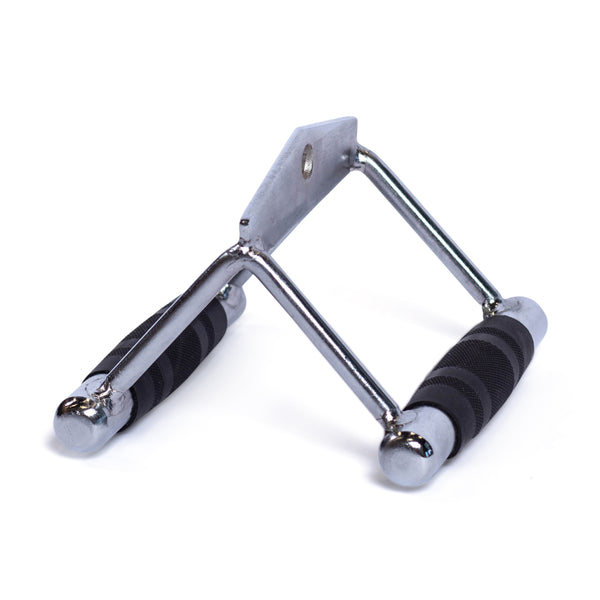
A landmine "Viking press attachment" or "Viking press handle" turns a standard landmine into a true two-handle Viking press by clamping onto the bar and providing parallel grips. This setup is closer to the real exercise than a single-bar landmine press, and it costs significantly less than a 3-in-1 machine. The downside is loading capacity — most landmine attachments cap at around 200 lb, well below what a dedicated machine can handle.
Option 3: Dedicated Viking press station (best for strongman gyms)
The strongman gym setup. A standalone Viking press is a vertical post with two pivot handles at the bottom and weight-loading sleeves out at the ends of the handles. You stand inside the V of the handles and press them upward. It is the truest version of the exercise, and it is also a 100+ lb piece of equipment that does one job.
Worth it if you are competing in strongman or you have unlimited space and budget. Overkill for a typical home gym — you are dedicating a 6–8 square foot floor area to a press-only machine that gets used 1–2 times a week.
Why we recommend the 3-in-1 approach for most home gyms
Floor space is the #1 constraint in nearly every home gym we ship to. Adding a dedicated single-purpose machine for an exercise you will do 1–2 times a week is hard to justify. A 3-in-1 machine that includes Viking press as one of three functions changes the math — you are getting a heavy quad builder, a calf raise station, and a Viking press for less square footage than a single dedicated machine.
The Bells of Steel pick: Pandemonium Squat (3-in-1 with Viking Press)

The Pandemonium Squat is a single-upright machine that combines a pendulum squat, a calf press, and a Viking press into one piece of equipment. It uses three peg levels to accommodate lifters up to about 6'5", a removable back pad with magnetic pins, and a counterbalance arm that smooths out the resistance curve.
The Viking press station mounts on the same upright as the pendulum squat, which is what makes the footprint work — you are not dedicating a second wall to a press-only machine. Switching between functions takes about 30 seconds. For lifters who want a real Viking press in a real garage gym without sacrificing the floor space, this is the cleanest answer in our catalog.
Pandemonium Squat key specs
- 3-in-1 functionality: pendulum squat, Viking press, calf press (also dips, pull-ups, rows)
- Lifter height range: accommodates lifters up to ~6'5"
- Single tall upright: three peg levels, magnetic-pin removable back pad
- Counterbalance arm: smooths the resistance curve through the press
- Footprint: compact for a 3-in-1 machine, fits standard garage gym layouts
- Price: $1,749.99 USD
Build Quads of Steel with the Pandemonium Squat — full demo of the pendulum squat function (the Viking press shares the same upright):
Viking press exercise variations
The Viking press is more flexible than its strongman roots suggest. Here are nine variations that change the stimulus without changing the machine.
- Standard Viking press: hip-width stance, neutral grip, controlled tempo. The default.
- Push press: add a small dip-and-drive of the legs to overload the press. Lets you use 10–20% more weight than a strict press.
- Strict press: no leg drive, no momentum. Pure shoulder and tricep strength.
- Pause press: 2–3 second pause at the bottom. Builds raw bottom-end strength.
- Tempo press: 4-second eccentric on every rep. Brutal hypertrophy stimulus.
- Single-arm Viking press: one handle at a time. Adds a rotational core challenge and exposes side-to-side strength imbalances.
- Half press: only the bottom half or top half of the rep. Useful for working past sticking points.
- Banded Viking press: attach bands to the handles for accommodating resistance at lockout.
- Behind-the-neck Viking press: some attachments allow this; useful for lifters with strong shoulder mobility who want a different stimulus.
How to program Viking presses
The Viking press fits into a home gym's pressing rotation in three useful ways:
As your primary heavy press (best for shoulder-limited lifters)
If barbell overhead pressing aggravates your shoulders, make the Viking press your main heavy press and demote the barbell to accessory work. Heavy sets of 3–5 on the Viking press build pressing strength as effectively as a barbell overhead press would, with much less shoulder cost. Run a 5/3/1 cycle, a 5x5 program, or any standard pressing template — just substitute Viking press for overhead press as the main movement.
As a heavy accessory after benching (best for raw pressing development)
Bench day finishers do not get more brutal than 4 sets of 8–12 on the Viking press right after your main bench work. The triceps and front delts are already pre-fatigued from benching, and the Viking press hits both directly. Most lifters can run this for 6–8 weeks before they need to deload.
As a high-volume hypertrophy lift (best for shoulder mass)
Sets of 12–20 on a Viking press build front and side delts as well as anything in lifting. The fixed path lets you push to true muscular failure without form breaking down — something a barbell overhead press does not allow because form goes long before failure does.
What to skip it for
Do not make the Viking press your only press. Free-weight pressing — barbell, dumbbell, kettlebell — builds stabilizers a fixed-path machine cannot. Use the Viking press as your heavy primary and round out with free-weight accessory work. The strongest pressers in the world all train both.
Common questions about the Viking press
Is a Viking press better than a regular overhead press?
For some jobs, yes. For others, no. A Viking press is better than a barbell overhead press for shoulder-friendly heavy loading, for high-volume work, and for any lifter whose shoulders will not tolerate a strict barbell press. A barbell overhead press is still better for stabilizer development, for athletes whose sport requires bar overhead loading, and for lifters who want the truest test of total-body pressing strength. Most lifters benefit from both — Viking press as the heavy primary, barbell overhead press as an accessory.
How much weight can you Viking press?
For most lifters, more than they think. The fixed path and angled grip let recreational lifters Viking press 50–100 lb above their barbell overhead press. Strongman competitors regularly Viking press over 300 lb. The weight cap on a home gym Viking press station is typically 600–700 lb, which is more headroom than nearly any home lifter needs.
How much does a Viking press weigh?
A standalone Viking press machine typically weighs 100–200 lb depending on construction. The Pandemonium Squat (which includes a Viking press function) weighs more because it is also a pendulum squat machine, but the total footprint is smaller than two separate machines would require. Landmine Viking press attachments weigh much less — usually 5–15 lb — but they require a barbell and a landmine base to function.
What is the difference between a Viking press and a landmine press?
A Viking press uses two parallel handles pressed simultaneously along a vertical-ish arc. A landmine press uses one barbell pressed at an angle from the shoulder. The press paths are similar — both are angled, both are fixed — but the Viking press is symmetrical (both arms working evenly) and the landmine press is usually one-arm or asymmetric two-arm. Viking press loads heavier and tests pure pressing strength. Landmine press loads lighter and adds a rotational or anti-rotational component.
What is a Viking press attachment?
A Viking press attachment is a hardware add-on that converts a standard landmine setup or rack into a Viking press station. There are two common types. The first is a landmine Viking press handle — a steel attachment that clamps onto a barbell loaded into a landmine, providing two parallel grips for pressing. The second is a fixed Viking press station that mounts to a rack or wall, providing a true two-handle press path with weight-loading sleeves at the ends of the handles. Both are alternatives to buying a dedicated Viking press machine.
Can I do a Viking press without a machine?
Sort of. A landmine attachment plus a barbell plus a Viking press handle attachment can simulate a Viking press for moderate weights. It is a reasonable starting point if your budget does not stretch to a dedicated machine. But once you are pressing heavy — 150 lb and above — the asymmetric loading of a one-bar landmine setup becomes a problem and a true Viking press station starts to make more sense.
What is a good Viking press alternative if I cannot get one?
The closest alternatives are: a high-incline dumbbell press (similar press path, free weight stability demand), a standing landmine press (similar angled press, single-arm), or a Smith machine incline press (fixed path, similar angle). None of them are identical to a Viking press, but each captures part of the benefit. For lifters with bad shoulders specifically, the high-incline dumbbell press is the closest free-weight substitute.
Do I need a Viking press if I have a Swiss bar?
Both are shoulder-friendly press tools, but they do not do the same thing. A Swiss bar (multi-grip bar) is for benching and overhead pressing with neutral grips — it changes the wrist angle but the press path is unchanged. A Viking press changes the entire press path so the bar travels at an angle. They complement each other rather than replace each other. Most lifters with shoulder issues end up using both: Swiss bar for bench, Viking press for overhead.
Is the Viking press worth it for a home gym?
Yes — with a caveat. A standalone Viking press is hard to justify in a typical home gym because of the floor space cost. A Viking press built into a multi-function machine like the Pandemonium Squat is a different conversation: you are getting three functions in the footprint of one. For lifters who want shoulder-friendly heavy pressing without dedicating a corner of the gym to a single-use machine, a 3-in-1 with a Viking press station is one of the highest value-per-square-foot options in home gym strength equipment.
The bottom line
The Viking press is the most underrated heavy press in lifting. It loads heavy, hits the shoulders and triceps hard, and does it without the joint cost of a strict barbell press. Most home gyms skip it because they think of it as a strongman novelty — and they are wrong. It is a mainstream training tool that happens to come from a strongman lineage.
If you are shopping for a Viking press, the right path for most home gyms is a 3-in-1 squat machine like the Pandemonium Squat that includes a Viking press station built in. You get heavy quad work, calf training, and a real Viking press in one piece of equipment, in a footprint that fits a real garage. That is how you actually add a Viking press to a home gym without rebuilding the gym around it.
Add a Viking press to your home gym
The Pandemonium Squat is a single-upright 3-in-1 with a built-in Viking press station — heavy pressing, pendulum squats, and calf training in one footprint.