A sandbag workout uses a soft, weight-filled bag to train functional, full-body strength. Because the sand or rubber filler constantly shifts, your stabilizing muscles work overtime to control the load — building the kind of real-world strength a rigid barbell can't replicate. Start with basics like the clean, shouldering, and bear-hug squat, and progress the weight as you get stronger.
Barbells and dumbbells are brilliant for one thing: moving a predictable load along a predictable path. But almost nothing in real life is predictable. The couch you carry upstairs, the child you hoist onto your shoulders, the log you drag across the yard — they shift, sag, and fight back. That's exactly the gap a sandbag workout fills, which is why sandbag training has become a staple in garages, backyards, and functional-fitness gyms everywhere.
Below you'll find what a sandbag workout actually is, why shifting load is the secret ingredient, how sandbag training stacks up against the barbell, the best sandbag exercises to start with, a full sample workout, and how to choose the right weight.
What is a sandbag workout?
A sandbag workout is any strength or conditioning session built around a filled training sandbag — a durable bag loaded with sand or rubber crumb, usually fitted with multiple handles. Instead of gripping a fixed bar, you clean, press, squat, carry, and throw a soft, awkward, live-feeling load. That awkwardness is the point: sandbag exercises recruit your whole body and force your core and stabilizers to work continuously, not just at the top of a lift.
Sandbag training scales to any level. A 50 lb bag is plenty for learning the movements and building conditioning; heavier bags turn the same moves into serious strength work. And because a single bag replaces a rack of equipment, it's ideal for a backyard or garage setup.
Why shifting load builds real-world strength
Here's the mechanism. When you lift a barbell, the weight is rigid and balanced, so your body follows efficient path and let the prime movers do the work. When you lift a sandbag, the filler slides toward the low point of the bag the instant you move. The load is never where you left it. To stop it from pulling you off balance, your deep core, grip, shoulders, and hips fire constantly to stabilize — through the entire rep, not just the sticking point.
That constant micro-correction is what carries over to real life and sport. You're not just training a movement; you're training your ability to own an unstable object. It's also humbling: most people can shoulder or carry far less in a sandbag than they can with a dumbbell farmer's walk, because the bag exposes every weak link. The benefit of sandbag training is that it strengthens those links directly.
A barbell only asks your prime movers to fire. A sandbag makes every stabilizer join in, because the load never sits still — it's always trying to escape. That's the closest thing to lifting a real object you'll get in a gym, and it's why sandbag strength carries over to everything from moving day to the field.
Sandbag vs. barbell: what's the difference?
This isn't sandbag instead of barbell — the two do different jobs, and most well-rounded home gyms use both. But if you want to understand where a sandbag earns its place, the sandbag vs. barbell comparison makes it clear.
| Factor | Sandbag | Barbell |
|---|---|---|
| Load behavior | Shifts constantly; unstable | Rigid and balanced |
| Primary benefit | Stabilizers, core, grip, real-world carryover | Maximal load, precise progressive overload |
| Best for | Carries, shouldering, conditioning, functional strength | Heavy squats, deadlifts, presses, strength numbers |
| Skill/setup | Low — grab and go, no rack needed | Higher — plates, rack, technique for max lifts |
| Footprint | One bag; stores anywhere | Bar + plates + rack |
| Weight jumps | Refill or swap bags | Micro-plates for precise increments |
Bottom line: the barbell wins on raw, measurable strength; the sandbag wins on stability, grip, and carryover to unpredictable, real-world loads. Together they cover far more than either does alone.
What muscles do sandbag workouts work?
Because the load is unstable, sandbag workouts are relentlessly full-body — but a few areas do the heavy lifting:
- Core & trunk: Anti-rotation and anti-flexion demand is constant. Core bag exercises like the bear-hug squat and rotational lunge turn your midsection into the star of the show.
- Posterior chain: Glutes, hamstrings, and lower back drive deadlifts, cleans, and shouldering.
- Grip & forearms: Awkward handles (and bear-hug holds with no handles at all) tax your grip hard.
- Shoulders & upper back: Cleans, presses, and carries load the shoulders and upper back through long time-under-tension.
- Legs: Squats, lunges, and carries build the quads and hips.
Carries deserve a special mention — sandbag carry muscles worked include practically everything, since your entire body braces to keep a shifting load pinned in place while you walk.
The best sandbag exercises
Here are the core sandbag exercises to build your training around. Master the first few before adding the rest.
1. Sandbag Deadlift
Feet hip-width apart, bag on the floor between them. Hinge at the hips, grip the side handles, and stand tall by driving the hips forward. The foundational hinge — and the safest way to learn to brace against a shifting load.
2. Sandbag Clean
From a deadlift start, explosively extend the hips and pull the bag to your chest, catching it in a front-rack or bear hug as you manouver under the bag. The go-to power move and the entry point to most complexes.
3. Shouldering
Clean the bag, then drive it up and over one shoulder; lower under control and alternate sides. The signature sandbag movement — brutal, athletic, and hugely carryover-friendly.
4. Bear-Hug Squat
Wrap your arms fully around the bag and squat. No handles means your core and upper back fight to keep the load from sliding down — a top-tier core bag exercise.
5. Zercher Squat
Hold the bag in the crooks of your elbows and squat. Loads the quads and demands a rock-solid, upright torso.
6. Overhead Press
From the front rack, press the bag overhead. The soft, uneven load makes your shoulders stabilize in every direction at once.
7. Bent-Over Row
Hinge and row the bag to your stomach using the handles. Builds the upper back and reinforces the hinge brace.
8. Rotational Lunge
Hold the bag at your chest, step into a reverse lunge, and rotate the bag over the front leg. Trains the core through rotation while the legs work — real-world movement in one rep.
9. Sandbag Good Morning
Bag on the back of the shoulders, soft knees, hinge forward and back. Isolates the posterior chain with a load that keeps trying to roll off.
10. Over-the-Shoulder Throw
Deadlift the bag and throw it up and over one shoulder to the ground behind you. Explosive power and conditioning in one — best outdoors or in a garage with space.
11. Sandbag Carry (Bear Hug / Front Rack / Zercher)
Pick the bag up and walk. Simple, savage, and one of the most transferable strength builders there is. Vary the hold to shift the emphasis.
12. Sandbag Get-Up
From lying to standing while keeping the bag secured to your chest or shoulder. Full-body stability and control from the ground up.
A sample full-body sandbag workout
One of the best sandbag workouts for beginners is a simple full-body circuit. It doubles as a starter sandbag workout program — repeat it 2–3 times per week and add weight or rounds as you progress.
| Exercise | Reps | Notes |
|---|---|---|
| Sandbag Deadlift | 10 | Set the brace; own the hinge. |
| Sandbag Clean | 8 | Explosive hips. |
| Bear-Hug Squat | 10 | Chest tall, elbows in. |
| Shouldering | 5 / side | Alternate shoulders. |
| Bent-Over Row | 10 | Squeeze the upper back. |
| Bear-Hug Carry | 20 m | Finisher — don't let the bag slip. |
Rest 60–90 seconds between rounds. Complete 3–5 rounds. Once six rounds feels manageable, it's time for a heavy sandbag workout — bump the weight rather than the reps.
How heavy should your sandbag be?
Sandbags feel far heavier than the number on them because of the shifting load, so size down from what you'd expect on a barbell.
- Beginners / conditioning: 50 lb. Enough to learn every movement and get a real workout.
- Most intermediate lifters: 100 lb — the workhorse. A classic 100 lb sandbag workout of cleans, squats, and carries will challenge nearly everyone.
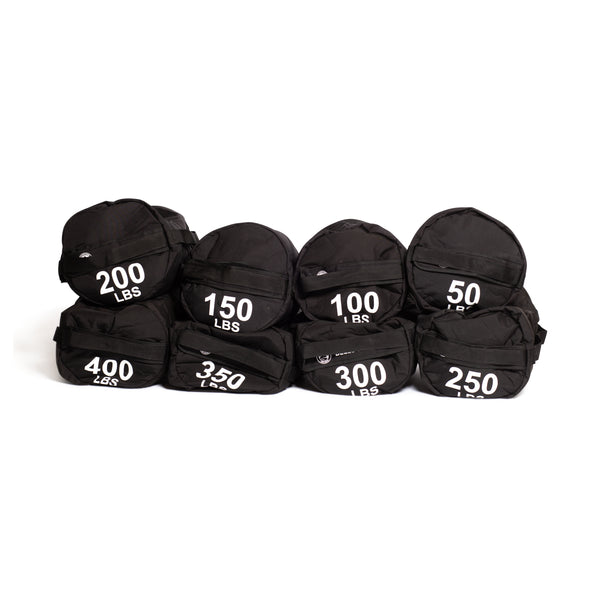
- Strength-focused / larger athletes: 150–250 lb for heavy shouldering, carries, and deadlifts.
You can buy a single bag or a matched set — the Fitness Sandbags page carries both individual sizes and money-saving sets, so you can load lighter for conditioning and heavier for strength without guessing.
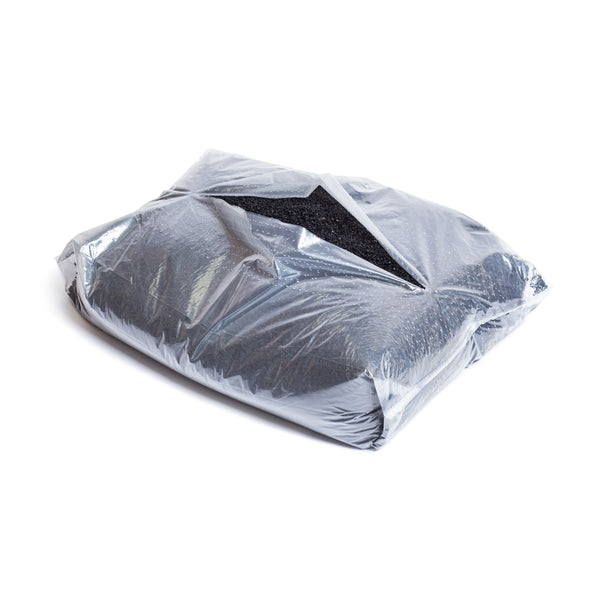
Bells of Steel sandbags arrive unfilled so shipping stays affordable and you control the weight. Fill them with sand or, for a cleaner and more durable option, our Recycled Tire Rubber Crumb Filler — a 40 lb bag of 1–3 mm crumb that packs tight and won't leak fine sand everywhere. Plan on filler when you order.

Fitness Sandbags
The workhorse behind every sandbag workout on this page. Three handles, a bombproof outer shell, and sizes from 50 to 250 lb — available individually or as money-saving sets, all on one page. Ships empty; add filler below.
From $60.99
Shop Fitness Sandbags
Rubber Crumb Filler
Your sandbag ships empty — fill it right. This 40 lb bag of recycled 1–3 mm crumb rubber packs tighter than sand, won't leak, and made-in-Alberta durable. Grab one (or a few) with your bag.
From $93.99
Shop Rubber Crumb FillerBuilding a full outdoor setup? See our Backyard Training Bundle for how the sandbag fits alongside the rest of your backyard gym. Want to add load to your bodyweight days too? Pair it with a weighted vest.
Sandbag workout FAQ
Are sandbag workouts effective?
Yes. Because the load shifts, sandbag workouts recruit more stabilizing muscles than fixed weights and build full-body, real-world strength, grip, and conditioning. They're used by functional-fitness athletes, military and tactical trainees, and home lifters alike.
What size sandbag should a beginner get?
A 50 lb sandbag is ideal for most beginners — enough to learn every movement and get a genuine workout. If you're a larger or already-strong lifter, 100 lb is a better starting point, since sandbags feel heavier than the number suggests.
Can a sandbag replace a barbell?
Not entirely — they do different jobs. A barbell is better for maximal, precisely progressed strength; a sandbag is better for stability, grip, and real-world carryover. Most home gyms benefit from having both, but a single sandbag is a remarkably complete tool on its own.
What muscles does a sandbag workout target?
All of them, but especially the core, posterior chain (glutes, hamstrings, lower back), grip and forearms, and shoulders. The constant need to control a shifting load keeps your stabilizers engaged the entire time.
How often should I do sandbag workouts?
Two to three full-body sessions per week is a great starting point, with rest days in between. As you adapt, progress by adding weight rather than endlessly adding reps.
Do Bells of Steel sandbags come filled?
No — sandbags ship empty so shipping stays affordable and you choose the weight. Fill yours with sand or, for a cleaner and longer-lasting option, our Recycled Tire Rubber Crumb Filler (a 40 lb bag of 1–3 mm crumb that packs tight and won't leak). Order filler at the same time as your bag.