The short answer
Buy bumper plates if you drop the bar, iron plates if you don't, and calibrated plates only if you're chasing competition-legal weights to the gram. Bumpers are rubber-coated, 450 mm in diameter regardless of weight, and built to survive being dropped from overhead — essential for Olympic lifting and CrossFit. Iron plates are thinner, cheaper per pound, and let you pack more weight on the bar — ideal for powerlifting training, bodybuilding, and any lifter who doesn't drop loaded bars. Calibrated plates are a specialized type of iron plate built to IPF weight tolerances (usually ±10 grams) with color-coded weights — worth it for competitive powerlifters, overkill for everyone else. For most home gyms, the right answer is a set of iron plates as your daily driver plus a small set of bumpers for deadlifts and any dynamic lifting.
Prefer video? Kaevon walks through every plate type we build and who each one is for:
Why your plate choice actually matters
Most lifters think a plate is a plate. It isn't. The material and construction of your weight plates affects four things that show up every single session:
- What lifts are safe. Drop a barbell loaded with iron plates from overhead and something breaks — the bar, the plates, or your floor. Bumpers are designed to be dropped; iron is not.
- How much weight fits on the bar. Bumper plates are thick. Iron plates are thinner. Calibrated plates are the thinnest of all. On a 7-foot Olympic bar, that difference is the gap between being able to load 500 lb per side and only fitting 405 lb.
- How accurate the load is. Standard plates (bumper or iron) are typically accurate to ±3%. Calibrated plates are accurate to ±10 grams or ±0.1%. If you're about to open at 600 lb on the deadlift in a federation meet, that gap matters.
- How the bar feels. A bar loaded with thin steel plates feels stiff and responsive. The same weight on thick virgin-rubber bumpers feels softer with a slight damped bounce in the setup. Both feel fine once you're under the bar — but the feel is different and worth noting.
The right plate choice is the plate that matches what you actually do. Olympic lifters and CrossFitters need to drop the bar, so they need bumpers. Powerlifters need max weight on the bar, so they want thin iron or calibrated. General strength trainees land somewhere in between and usually want a mix.
This guide walks through all three plate types in detail — what they're made of, how they load, when to use them, and the specific Bells of Steel options that fit each use case.
Bumper vs iron vs calibrated plates at a glance
Here's how the three plate families stack up across the specs that matter most. Use this as a quick decision matrix, then read the detailed breakdowns below.
| Feature | Bumper Plates | Iron Plates | Calibrated Plates |
|---|---|---|---|
| Material | Rubber over steel insert hub | Cast or machined iron | Calibrated steel (often powder-coated) |
| Diameter | 450 mm (17.7") for all weights | Varies by plate weight | 450 mm (IPF standard) |
| Thickness (45 lb) | ~3.0"+ (virgin rubber thickest) | ~1.25–1.5" | ~1.0–1.1" (thinnest) |
| Droppable | Yes — designed for it | No — risks breaking plates, bar, and floor | No — and don't, they're expensive |
| Weight tolerance | Typically ±3% | Typically ±3% | ±10 g or ±0.1% (IPF-tested) |
| Max weight on bar | Limited (plates are thick) | High | Highest (plates are thinnest) |
| Best for | Olympic lifting, CrossFit, deadlifts, any lift you might drop | Powerlifting training, bodybuilding, squats, bench, accessories | Powerlifting meets and near-competition training |
| Relative cost per pound | Mid to high | Low to mid | High |
Now let's break down each plate type — what they actually are, how they differ within their own family, and when each one is the right buy.
Bumper plates: what they are and when to use them
What is a bumper plate?
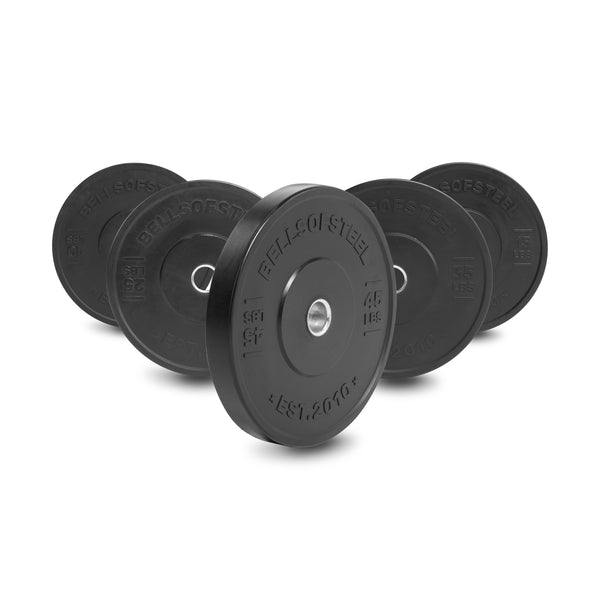
A bumper plate is a weight plate built around a steel insert hub wrapped in a thick layer of rubber. Every bumper — whether it's a 10 or a 55 — is built to the same 450 mm (17.7-inch) diameter, the international IWF standard for Olympic weightlifting. Heavier bumpers just get thicker; diameter stays constant.
The entire point of that construction is drop tolerance. In the snatch and clean & jerk, the bar gets driven overhead and dropped from the top of the lift. Iron plates wouldn't survive that. Bumpers will — for thousands of reps. The rubber absorbs the impact and protects the bar, the plates, and your floor.
Bumpers are also the only plate type where the 10 lb plate is the same diameter as the 45. That means the moment the bar hits the floor on a deadlift or an Olympic lift, the bar is at the correct pulling height no matter what you've loaded. Iron 10-pounders are much smaller and would leave the bar sitting awkwardly low.
The bumper plate sub-types, explained
"Bumper plate" covers several sub-types that behave differently. The three most common:
- Virgin rubber bumpers — The premium option. Made from fresh (non-recycled) rubber, these are the most durable, have the cleanest branding, and have the most predictable bounce behavior. They're also the thickest. Best for lifters who drop the bar regularly and want plates that last 10+ years.
- Dead bounce / low bounce bumpers — A specialized bumper built with a harder rubber formulation that absorbs more of the drop energy and bounces less. Safer in smaller gym spaces where a bouncing barbell could hit the rack or a wall. Our Dead Bounce Conflict Bumper Plates fit here.
- Urethane bumpers — Built with urethane instead of standard rubber. Thinner than virgin rubber bumpers for the same weight, more durable, don't smell as strong, and much more expensive. Often the choice for commercial gyms or lifters who want the closest thing to a competition-grade plate without the full competition price tag.
- Competition bumpers — IWF-spec plates designed for international Olympic weightlifting meets. Color-coded to IWF standards (yellow 15 kg / 35 lb equivalent, blue 20 kg / 45 lb equivalent, etc.), thinnest of the bumper family, tightest weight tolerance within the bumper category. The right plate if you're training for an Olympic weightlifting meet.
The Bells of Steel bumper lineup covers all of these tiers. For most home gym lifters, a dead-bounce or virgin-rubber bumper is the right pick — competition bumpers are built for a specific use case most trainees don't need.
When to buy bumper plates
Buy bumper plates if any of the following apply:
- You do Olympic lifting (snatch, clean & jerk, and their variants)
- You do CrossFit-style training with frequent barbell drops
- You deadlift heavy and want to be able to drop the bar at the top of the rep instead of trying to control it back down
- Your gym is in a garage, basement, or over-slab space where dropping iron would damage the floor
- You train with a barbell on grass, concrete, or stall mats that wouldn't survive iron impact
Flagship bumper: Dead Bounce Conflict Bumper Plates

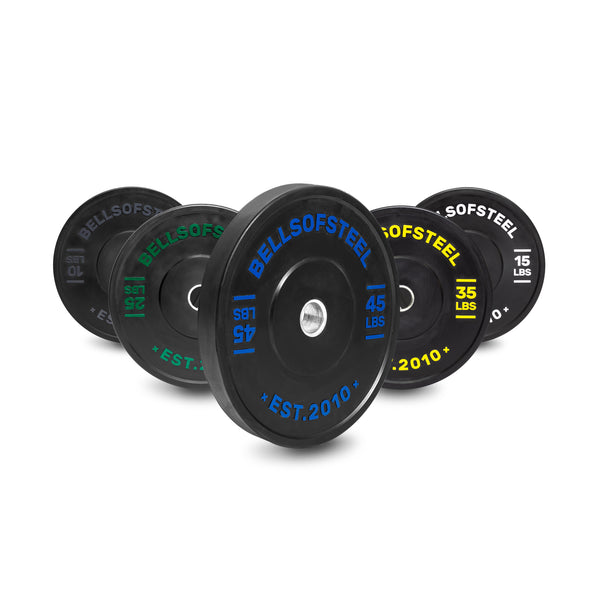
Our Dead Bounce Conflict Bumper Plates are the bumper we recommend for most home gym lifters. Here's why:
- Virgin rubber construction — clean branding, no rubber smell, consistent density plate-to-plate
- Dead-bounce formulation — the bar doesn't rocket away from you after a drop, which matters in garage gyms and tight spaces
- Stainless steel insert hub — won't rust, doesn't chew up the sleeve on your barbell, stays tight in the rubber over time
- Color-coded weight text — 45, 35, 25, 15, and 10 lb options with readable weight callouts
- Rated for drop from overhead — the plate is built for Olympic lifting and CrossFit training, not just finishing a deadlift
If you're setting up a home gym from scratch and you're going to be doing anything dynamic with the barbell — Olympic lifts, heavy deadlifts, any kind of CrossFit-style metcon — the Conflict Bouncers are the right foundation. Pair them with iron plates for everything that doesn't get dropped and you have a complete loading setup.
Iron plates: what they are and when to use them
What is an iron plate?
An iron plate is a solid cast-iron or machined-iron disc with an Olympic-size (2-inch / 50 mm) hole in the middle. No rubber coating, no steel insert — just iron. The heavier the plate, the larger the diameter and the thicker the plate, because mass has to come from somewhere and iron plates aren't all built to a fixed diameter the way bumpers are.
The payoff of all that iron is density. A 45 lb machined iron plate is usually around 1.25 to 1.5 inches thick. That's less than half the thickness of a virgin rubber 45 lb bumper. When you're loading a bar for a heavy squat or deadlift, that thickness difference is the reason you can fit 500 lb or more on an iron-loaded bar but cap out well below that with bumpers.
The trade-off is obvious: iron doesn't bounce. Iron doesn't absorb drops. Drop a loaded iron bar from overhead and you'll crack plates, bend bars, and destroy floors. Iron is for lifts that end under control — not for Olympic lifting.
The iron plate sub-types, explained
Not all iron plates are built the same. The main variations:
- Bare / painted cast iron — The classic "gym plate" look. Cast iron with a baked-on paint finish. Durable, cheap per pound, but the paint will chip over time, especially on the edges. Fine for anyone who doesn't mind some cosmetic wear.
- Machined iron — Iron plates where the faces and edges have been CNC-machined to tight tolerances. Flatter, more consistent plate-to-plate, stack better on the bar. Usually branded with inset or debossed logos rather than stickers. A step up in aesthetics and consistency over basic cast iron.
- Grip plates — Iron plates with multiple hand-holes drilled through the face. Makes loading and carrying dramatically easier, especially for 45 lb plates. Our Black Mighty Grip Iron Plates are in this family.
- Rubber-coated iron — Iron plates wrapped in a thin rubber coating. Quieter when racking, gentler on floors if you set the bar down hard. Thicker than bare iron because of the coating, but still much thinner than true bumpers. These are not drop-rated — the rubber is cosmetic, not structural.
- Urethane-coated iron — Similar to rubber-coated, but with urethane for better durability and a cleaner look. Typically a commercial-gym choice.
When to buy iron plates
Iron plates are the right call if:
- You're training primarily powerlifting, bodybuilding, or general strength — lifts that stay under control and end on the floor or in the rack, not overhead
- You need to load heavy weight. Once you're north of 315–405 lb on squats or deadlifts, iron becomes the only way to actually fit the plates on the bar
- You're building out a complete plate set on a budget — iron gives you the most pounds per dollar of any plate type
- You care about the density of the bar — thin plates feel noticeably different than thick bumpers when you're racking and unracking
- You want plates that handle decades of use — a bare-iron plate will outlast any rubber plate if you don't drop it
Flagship iron: Machined Iron Olympic Weight Plates

Our Machined Iron Olympic Weight Plates are our go-to iron plate for lifters who want a step up from basic cast iron without jumping all the way into calibrated territory.
- CNC-machined faces and edges — plates stack flush on the bar, no wobble, no gap between plates under load
- Tight tolerance plate-to-plate — consistent diameters mean your 495 deadlift looks and loads the same every session
- Full weight range — 45, 35, 25, 10, 5, and 2.5 lb options so you can micro-load for progressive overload
- Clean, debossed branding — no stickers to peel, no paint to chip in the first month
- Olympic 2"/50 mm hub — fits any standard Olympic bar without slop
If you're building a powerlifting or general strength setup and you don't need drop capability, start here. These are the plates that will spend the most time on your bar — everything else is a supplement.
For lifters who want the same iron density with an easier grip, the Black Mighty Grip Iron Plates offer the same core construction with tri-grip hand-holes cast into the face. Worth looking at if you're routinely solo-loading heavy singles or pulling plates on and off the bar dozens of times per session.
Calibrated plates: what they are and when to use them
What is a calibrated plate?
A calibrated plate is a precision-manufactured steel plate built to IPF (International Powerlifting Federation) standards. The two things that define it:
- Weight tolerance. Where a standard iron plate might be accurate to ±3% (meaning your "45" could actually be a 43.6 or a 46.4), a calibrated plate is accurate to within ±10 grams — about 0.05%. Every plate in a set of calibrated 55s weighs essentially the same as every other plate in that set, to the gram.
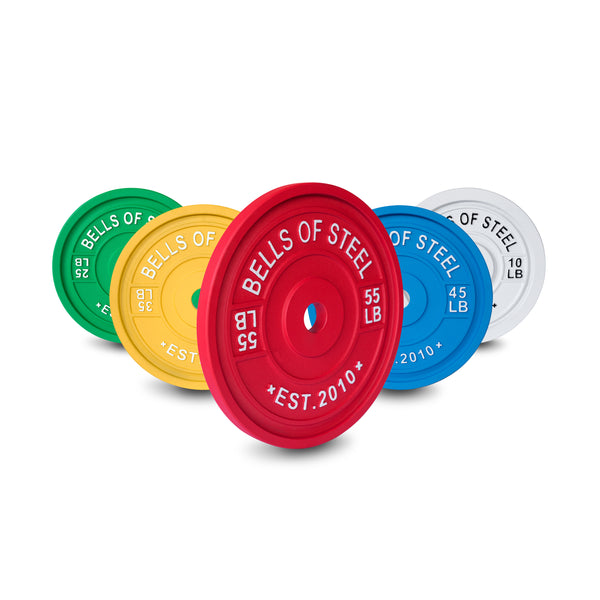
- Standardized color-coding. The IPF assigns each plate weight a specific color so officials can identify the load on a bar from across the platform. In LB sets: red is 55 lb, blue is 45 lb, yellow is 35 lb, green is 25 lb, white is 10 lb. (In KG sets: red 25 kg, blue 20 kg, yellow 15 kg, green 10 kg, white 5 kg.)
Calibrated plates are also the thinnest plate type — significantly thinner than standard machined iron. That's because the plates are made from dense calibrated steel, often with a precision-milled thin profile, which lets powerlifters fit truly huge weights on a 7-foot bar. On a competition bar with strong collars, you can get deep into the 800s before you run out of sleeve.
What's NOT a calibrated plate
This is where a lot of lifters get burned buying online. A lot of products get called "calibrated" that aren't actually built to calibration tolerance. Red flags to watch for:
- No published weight tolerance. A true calibrated plate will have its tolerance printed on the plate or in the spec sheet — usually ±10 g or ±0.1%. If a plate is "color-coded" but the brand doesn't publish its tolerance, it's a painted iron plate, not a calibrated plate.
- Cast (not machined) construction. You can't hit calibration tolerance with a cast plate — the process isn't precise enough. Calibrated plates are machined from calibrated steel.
- Price that's suspiciously close to standard iron. Calibrated plates cost significantly more than standard iron because the manufacturing process is more expensive. If the price looks like iron-plate pricing, the spec probably isn't real calibration.
When to buy calibrated plates
Calibrated plates are a specialist tool, not a daily-driver plate for most lifters. Buy them if:
- You're a competitive powerlifter and you want your training weights to match the plates you'll lift at a meet
- You're approaching big PRs (600+ lb squats, 700+ lb deadlifts) and you're running out of sleeve space on your bar with standard iron
- You run attempt simulations before meets and you want to know the bar weight is right to the gram, not to the pound
- You value the visual feedback of IPF color-coding on the bar — it's easier to eyeball loads with color-coded plates than to count black iron
Calibrated plates are overkill for a home gym that's built around general strength training. If you're not planning to ever set foot on a powerlifting platform, buy good machined iron and spend the difference on something else — a better bar, more bumpers, a specialty piece.
Flagship calibrated: Calibrated Powerlifting Plates (LB)

The Calibrated Powerlifting Plates - LB are our plates for competitive powerlifters and advanced strength trainees. What you're paying for:
- IPF-spec color coding in LB — red 55, blue 45, yellow 35, green 25, white 10. Match the visual load you'll see at a meet.
- Precision calibration tolerance — every plate is built and tested to a tight tolerance, so a "500" attempt actually weighs 500
- Thin profile — calibrated steel construction with a slim profile so you can load more weight on the bar than you can with bumpers or standard iron
- Powder-coated finish — the color-coded finish is baked on, not stickered, and resists chipping under normal racking and loading
- Machined edges — plates load and stack flush, no gaps or wobble with proper collars
A KG-spec version is also available for lifters training to European-federation standards. The LB version is the right pick for most North American lifters who are prepping for USAPL, USPA, or other LB-scale federations.
Can I mix bumper and iron plates on the same bar?
Yes — and most experienced lifters do. There's a right way to load a mixed-plate bar, and a wrong way.
The right way: bumpers inside, iron outside
If you're working up to a heavy deadlift and you have a mix of bumper and iron plates, the correct loading order is:
- Bumpers go on the bar first, closest to the sleeve shaft
- Iron plates go on after the bumpers, outside them
- Finish with smaller bumpers or iron change plates, then collar
This matters for two reasons. First, if you have to bail on a rep, the bumpers take the impact on the floor and absorb the energy — the iron plates outside them aren't the ones hitting the ground with full force. Second, when you're setting up a deadlift, the bumper on the inside keeps the bar at the correct height off the floor (because bumper diameter is fixed at 450 mm), even if the smaller-diameter iron change plates outside them wouldn't reach the floor on their own.
When to go pure iron
For lifts that don't get dropped and never touch the floor mid-lift — bench press, overhead press, seated row, most accessories — there's no reason to use bumpers. Pure iron loads thinner, keeps the sleeve space open for more weight, and doesn't waste your rubber plates on lifts that won't stress them.
When to go pure bumpers
For Olympic lifts and any CrossFit-style training where drops are part of the movement, load bumpers only. Mixing iron in on a bar that's going to get dropped from overhead is how you crack iron and damage your bar.
Don't load a small iron plate on the inside
Common loading mistake: putting a small 10 lb iron plate on the bar first, then a 45 lb bumper outside it. The small iron plate sits between the bar shoulder and the bumper, which means the bumper doesn't make full contact with the sleeve — it rotates against the iron instead, over time chewing the insert. Iron small plates always go outside the bumpers, or on a pure-iron load.
Which plates should I buy first?
Real-world buying advice, sorted by what kind of lifter you are:
If you're a powerlifter or bodybuilder
Start with machined iron. Build out a full set in 45s and change plates (25s, 10s, 5s, 2.5s), then decide later if you need calibrated plates for meet prep. If you deadlift heavy and want to drop the bar at the top of the rep, add a pair of 45 lb bumpers for the innermost position. You don't need a full bumper set — just the inside pair.
If you're an Olympic lifter or CrossFitter
Start with bumpers. A full set of 45, 35, 25, 15, and 10 lb bumpers covers every Olympic training load. Add iron change plates (5s and 2.5s) later for micro-loading. You don't need iron 45s or 35s unless you're training for a strength sport on the side.
If you're a general strength / home gym lifter
Start with iron 45s and a single pair of 45 lb bumpers. This is the most common setup and it handles everything. Iron for squats, benches, overhead press, accessories; bumpers on the inside when you deadlift heavy. Fill in with iron 25s, 10s, 5s, and 2.5s as budget allows.
If you're training for a powerlifting meet within 6–12 months
Buy calibrated 55s, 45s, 25s, 10s, and at least one pair of 5s in IPF color. You want to train with the plates you'll lift at a meet so there are no surprises on attempt day. Your iron plates become a secondary set for accessory and general training work.
Five common plate-buying mistakes (and how to avoid them)
1. Buying all bumpers when you don't do Olympic lifting
Bumpers are more expensive per pound than iron and take up more sleeve space. If you're a powerlifter, bodybuilder, or general lifter, paying a premium for drop-rated plates you'll never drop is pure waste. Iron + a pair of bumpers is almost always the better buy.
2. Buying cheap "bumpers" that aren't actually drop-rated
Some budget "bumper plates" are really thin rubber-coated iron — they'll crack if you drop them from overhead. Check for a published drop rating and the 450 mm diameter before you buy. If the brand can't tell you the drop spec, they're not selling a real bumper.
3. Assuming calibrated plates are a status upgrade
Calibrated plates are a specialized tool, not a premium version of iron plates. If you're not competing in powerlifting, you'll get almost identical training results from good machined iron at significantly less cost.
4. Mixing bumper and iron plates in the wrong order
Small iron plates go outside bumpers, not inside them. Load bumpers closest to the sleeve shaft, iron outside. See the mixed-loading section above.
5. Forgetting about change plates
A full set of 45s isn't a full plate set. Progressive overload lives in the 2.5 and 5 lb jumps. Iron change plates (2.5, 5, 10, 25) are cheap, don't take up much space, and let you actually drive progression session to session. Every plate setup — bumper, iron, or calibrated — needs change plates.
Frequently asked questions
What's the difference between bumper plates and iron plates?
Bumper plates are rubber-coated around a steel insert and built to be dropped from overhead — every bumper is 450 mm in diameter regardless of weight. Iron plates are solid cast or machined iron, are not drop-rated, and have varying diameters based on plate weight. Bumpers are for Olympic lifting and CrossFit; iron is for powerlifting, bodybuilding, and general strength training.
Can you drop iron plates?
No. Iron plates are not engineered to absorb drop impacts. Dropping an iron-loaded bar from overhead — or even from waist height onto bare concrete — can crack plates, bend the bar, and damage the floor. If you're going to be dropping the bar, use bumpers.
Are calibrated plates worth it for a home gym?
For most home-gym lifters, no. Calibrated plates are specialized gear built to IPF tolerance (±10 g) for competitive powerlifting. If you're not training for a meet, good machined iron gives you essentially the same training quality for significantly less money. Save the calibrated investment for when you have a meet on the calendar.
Can I mix bumper and iron plates on the same bar?
Yes — most experienced lifters do. Correct loading order is bumpers closest to the bar shaft, iron plates outside the bumpers, then smaller change plates and the collar. This protects the iron from drop impact and keeps the bar at correct height on deadlifts because bumpers maintain the 450 mm diameter regardless of weight.
Do bumper plates weigh the same as iron plates?
A 45 lb bumper and a 45 lb iron plate both weigh 45 lb within their stated tolerance (usually ±3% for both). The difference isn't weight — it's construction, diameter, and thickness. Bumpers are thicker and bounce; iron is thinner and doesn't.
What are calibrated plates made of?
Calibrated plates are made from machined calibrated steel, typically with a powder-coated finish in IPF color-coded schemes. The manufacturing process is more precise than standard cast-iron plate production, which is what allows the tight weight tolerance (often ±10 grams).
Why are bumper plates more expensive than iron plates?
Bumper plates use more material per plate (rubber + steel insert, where iron plates are just iron), are manufactured to hold drop tolerance, and include an Olympic-spec 450 mm diameter that stays constant across weights. All three factors add cost per plate compared to a simpler iron disc.
Which plates do powerlifters use in competition?
IPF-affiliated federations (USAPL, USPA, and others) use calibrated plates in competition, color-coded to IPF standard. LB federations use red 55s, blue 45s, yellow 35s, green 25s, and white 10s. KG federations use red 25 kg, blue 20 kg, yellow 15 kg, green 10 kg, and white 5 kg. Training with calibrated plates that match the meet plates removes surprises on attempt day.
Should I buy bumpers or iron plates first?
Depends on the lifts. Olympic lifters and CrossFitters should start with bumpers. Powerlifters and bodybuilders should start with machined iron and add a single pair of 45 lb bumpers later for heavy deadlifts. General strength trainees benefit most from a mixed setup — iron as the daily driver, one pair of bumpers for anything dynamic.
How long do bumper plates last?
Quality virgin rubber bumpers with a steel insert should last 10+ years in a home gym with regular use, including drops. The plate to watch is the 10 or 15 lb bumper — the thinnest plate in the set, it takes the most stress per inch of rubber when dropped alone on an empty bar. Avoid dropping the bar with only 10s loaded if you can.
The bottom line
Pick your plates based on what you actually do under the bar. Bumpers if you drop the bar — Olympic lifting, CrossFit, heavy deadlifts you want to release at the top. Iron if you don't — powerlifting training, bodybuilding, general strength. Calibrated if you're chasing competition-legal weight and need IPF-spec color coding and ±10 gram accuracy.
For most home gym lifters, the right answer isn't all-of-one — it's a mix. Iron plates as your daily driver, a pair of bumpers for the inside position on deadlifts and anything dynamic, and a set of iron change plates so you can actually progress session to session. Add calibrated plates later if and when you put a meet on the calendar.
→ Shop the Dead Bounce Conflict Bumper Plates · → Shop Machined Iron Plates · → Shop Calibrated Powerlifting Plates