The short answer
30° is the best all-around incline bench angle for the upper chest. It activates the clavicular fibers of the pectoralis major more than flat pressing without turning the lift into a shoulder press. Use 15° when you want an incline feel while keeping most of the work on the mid-chest, 45° when you're chasing heavy shoulder involvement alongside upper chest, and 60°+ when you're effectively programming a seated overhead press. Most lifters get the best results using 30° as their primary incline angle and rotating in 15° or 45° as a secondary variation every 4 to 6 weeks.
Why does incline bench angle actually matter?
Your pectoralis major has two heads — the sternal head (lower and mid-chest) and the clavicular head (upper chest). The flat bench press biases the sternal head. As soon as you tip the bench up, the line of pull shifts toward the collarbone, and the clavicular fibers take on more of the load. Keep tipping the bench and eventually the front deltoid takes over and the chest checks out.
That's the whole point of incline pressing: you're steering the line of force relative to the chest and shoulder to change which muscle fibers do the most work. The angle isn't cosmetic — it changes the exercise. Getting it right is the difference between a movement that fills in the upper chest and one that just beats up your shoulders.
This is also why angle accuracy matters. A bench that reads "low incline" on a sticker but is actually sitting at 38° is quietly doing a different exercise than the one you programmed. More on that in the bench selection section.
Incline angle at a glance: 15°, 30°, 45°, 60°
Here's how each common incline angle stacks up for the lifter. Use this as a quick decision matrix, then read the detailed breakdowns below.
| Angle | Primary Target | Secondary Involvement | Best For |
|---|---|---|---|
| 15° (low incline) | Mid-chest with upper-chest bias | Front delt (light) | Powerlifters wanting incline work without deviating far from the bench groove; tall lifters with shoulder sensitivity. |
| 30° (classic incline) | Upper chest (clavicular head) | Front delt (moderate), triceps | Most lifters, most of the time. The "default" incline. |
| 45° (high incline) | Upper chest + front delt (split) | Triceps, upper traps | Bodybuilders emphasizing clavicular fibers and shoulder tie-in; rotational variation for seasoned lifters. |
| 60°+ (steep incline / near-vertical) | Front deltoid | Upper chest (minor), triceps | Seated overhead press variation. Call it what it is — it's not a chest exercise anymore. |
15° incline bench: the "barely off flat" angle
At 15° you're basically still bench pressing — the line of force is tipped just enough to bring a bit more clavicular fiber into play, but the sternal head and triceps still run the show. This is the angle you pick when you want some upper-chest carryover without straying far from your competition bench groove.
Who this is for:
- Powerlifters who compete at a legal bench arch and want to train the top of the press without fatiguing their shoulders.
- Tall or long-armed lifters whose shoulders get crunchy at steeper angles. 15° keeps the humerus in a friendlier path.
- Lifters returning from a shoulder injury who want gentle variation without committing to 30°+.
Pro tip: Most adjustable benches' lowest non-flat position lives somewhere between 15° and 20°. That's where the "low incline" is. If you want a true 15°, confirm your bench has laser-etched angle markings and a setting that hits it exactly.
30° incline bench: the default upper-chest builder
If you pick one incline angle and run it for years, pick 30°. It hits the clavicular fibers of the pectoralis major hard, still lets you press meaningful weight, and doesn't load the shoulders disproportionately. Almost every classic upper-chest program — from old-school bodybuilding splits to modern hypertrophy blocks — is built around roughly this angle.
What 30° does well:
- Maximizes upper-chest activation without letting the front delt dominate the lift.
- Allows heavy loading — most lifters press about 75–85% of their flat bench at this angle.
- Works with both barbells and dumbbells, and transfers cleanly to the Smith machine and chest press if that's what your setup supports.
Who this is for: honestly, almost everyone. Beginners building their first chest base. Intermediates running hypertrophy blocks. Advanced lifters who need a reliable upper-chest accessory. Default to 30° unless you have a specific reason not to.
Programming hint: Running 30° as your primary incline for 8–12 weeks before rotating to 15° or 45° tends to produce better results than angle-hopping every session. Give the adaptation time to land.
45° incline bench: where chest meets shoulders
At 45° you've split the lift roughly 50/50 between upper chest and front deltoid. This is a classic bodybuilding angle — popularized in old-school chest routines and still a favorite for lifters chasing a wide, high chest with a strong shoulder tie-in. It's more demanding on the shoulder joint than 30°, so it earns its place as a secondary angle rather than a default.
What 45° does well:
- Pushes harder on the clavicular fibers than 30° does in isolation.
- Builds pressing power in a steeper plane that carries over to overhead pressing.
- Gives a visible shoulder-chest seam — useful if you're training for physique work.
Who this is for: lifters who have mastered 30° incline and want a progression angle. Bodybuilders who value upper-chest fullness. Anyone running a 4-to-5-day bodybuilding split with dedicated upper-body sessions.
Watch out: if your shoulders get cranky at 45°, don't force it. Drop back to 30° and load it harder instead. There's no points awarded for pressing at a specific angle — only for progressive overload of a movement your joints can handle.
60°+ incline bench: you're overhead pressing now
Once the back pad approaches 60°, you've exited "chest exercise" territory and entered "seated overhead press with a back rest." The line of force is so vertical that the front deltoid is the prime mover and the upper chest is mostly along for the ride.
This isn't a bad thing — supported seated overhead pressing is a valid movement. Just be honest about what you're training. If you call a 60° press "incline bench," you'll be disappointed when your upper chest doesn't grow. Call it what it is — a seated press — and program it accordingly in your shoulder work, not your chest work.
Use steep angles when:
- You want supported overhead pressing but can't standing-press (lower-back issues, balance).
- You're training the front delt directly and want to recruit a bit of upper chest.
- You're adding volume to shoulder day and want a low-skill, high-stability option.
How to program incline pressing in your routine
The mistake most lifters make isn't choosing the wrong angle — it's running too many angles at once. Pressing at 15°, 30°, 45°, and 60° in the same week splits your effort across four slightly different stimuli when you could have put all of it into driving progress on one.
Here's how a strong weekly structure usually looks:
Option 1 — One primary incline angle (recommended for most lifters)
Pick 30° as your incline variation, treat it like a main lift, and drive progressive overload for 8–12 weeks before rotating to a different angle.
- Upper Day A: Flat bench press — 4×6 heavy
- Upper Day B: Incline barbell press at 30° — 4×8–10
- Accessories: Dumbbell flyes, dips, push-ups, lateral raises
Option 2 — Primary + secondary angle split
Use your lower-volume upper day for a secondary incline angle to hit the chest from a second line of force.
- Upper Day A: Flat bench 4×5 + 30° incline dumbbell press 3×10
- Upper Day B: 15° incline barbell press 4×6 + dumbbell bench 3×10
Option 3 — Block-periodized angle rotation
Advanced lifters can run a block structure where the primary incline angle rotates every 4–6 weeks.
- Block 1 (Weeks 1–5): 30° primary incline
- Block 2 (Weeks 6–10): 15° primary incline
- Block 3 (Weeks 11–15): 45° primary incline + return to 30° for maintenance
Whichever option you pick, log the angle every session. "Incline bench 4×10 at 30°" is a measurable target. "Incline bench 4×10" is not — you'll drift across angles week to week and wonder why you're not progressing.
Incline bench press form: what changes from flat
Incline pressing isn't just "bench press, but tilted." The mechanics shift in a few specific ways, and if you coach yourself with flat-bench cues at 30° you'll leave reps on the table.
- Set the seat and back pad together. A bench with a pad gap and a proper seat incline supports your pelvis so you don't slide down during heavy sets. Skipping the seat adjustment is the single most common incline press setup error.
- Keep shoulder blades retracted and depressed. Same as flat, but even more important — the tendency at incline is to shrug and let the shoulders roll forward.
- Bar path tracks the upper chest, not the face. At 30° the bar should come down to the top of the sternum, just below the collarbones. At 45° it moves higher, toward the clavicles.
- Elbows tuck slightly more than on flat. A flared incline press with dumbbells or a barbell is a recipe for anterior shoulder pain. Think 45–60° elbow angle relative to the torso.
- Leg drive still matters. Keep both feet planted and generate tension from the floor up, even though the angle takes some leg contribution out of the equation.
What to look for in a bench that actually hits the angles
Here's the dirty secret of home-gym incline training: a lot of adjustable benches don't hit clean, well-known angles. They advertise "seven positions" and leave you guessing whether you're at 28° or 34°. The difference sounds small, but if you're running a 12-week program you want the same angle every session.
Features that actually matter when buying a bench for incline pressing:
- Laser-etched angle markings (not stickers that peel). These are permanent and readable under load.
- Ladder-style back adjustment with enough positions to land on 15°, 30°, and 45°. Look for 6+ back pad angles as a minimum.
- Independent seat adjustment so you can set pelvis support for each incline angle. Without this, you slide down the pad on steeper angles.
- High-density, grippy pad that doesn't compress under load. Soft foam feels nice for a week and then leaves you fighting for stability at heavy weights.
- Minimal pad gap between the seat and the back pad so you don't lose range of motion or comfort on dumbbell work.
- Wide stabilizer foot to kill side-to-side wobble on heavy sets.
- Weight capacity that exceeds your loaded bar plus bodyweight by a wide margin. 1,000 lb is the modern home-gym standard.
Why the Buzz-Saw is our go-to for incline work
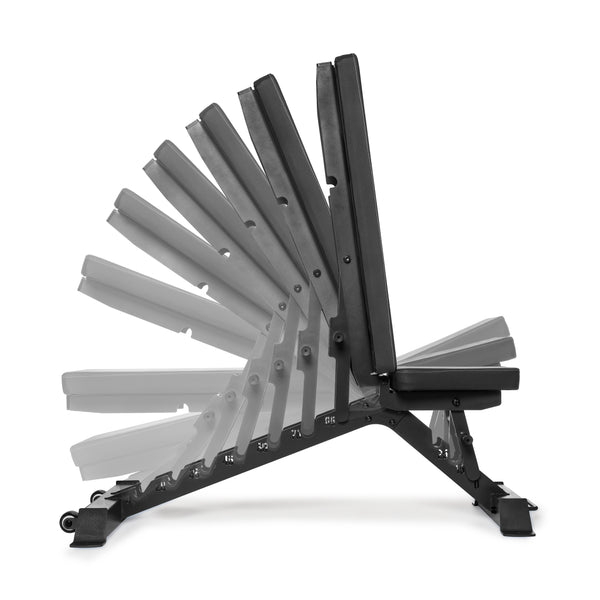
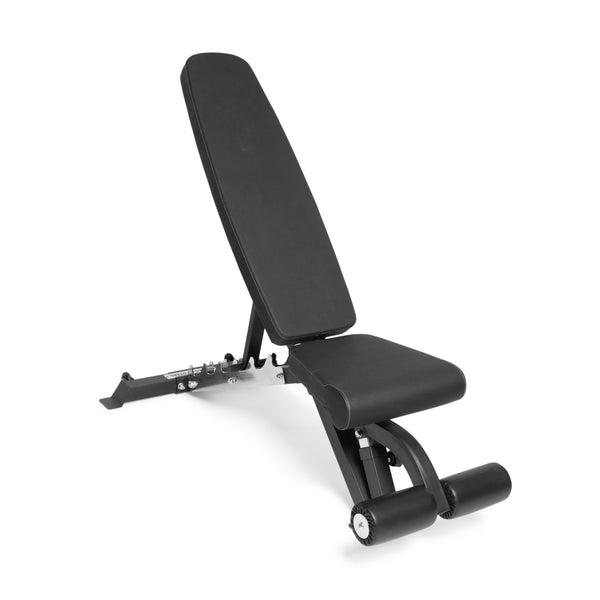
The Buzz-Saw Heavy-Duty Adjustable Bench is our flagship adjustable because it solves the specific problems that plague incline pressing on lesser benches — angle guesswork, pad slippage, wobble under heavy leg drive, and hardware that loosens over a few months of real use.

Buzz-Saw specs at a glance:
- Back pad angles: 8 positions (flat through upright)
- Seat angles: 3 positions for proper pelvis support at each incline
- Weight capacity: 1,000 lb (453 kg)
- Steel: 11-gauge tubing with reinforced stabilizer foot
- Pad thickness: 2.4" / 60 mm high-density foam with grippy textured upholstery
- Footprint: 55.5" × 26.25" (1,410 × 667 mm)
- Height: 18.1" / 459 mm
- Angle markings: Laser-etched, permanent
- Warranty: Limited Lifetime (frame), 180 Days (wheels & upholstery)
- Attachments available: Preacher curl, leg extension/curl, and decline
The laser-etched angle guides hit the clean numbers — 15°, 30°, 45°, 60°, and upright — so you're not squinting at a sticker trying to replicate last week's setup. The stabilizer foot kills wobble on heavy incline presses where other benches shift under leg drive. And the pad holds you in place on 45° and 60° sets where cheaper benches send you sliding down the pad.
If you're pressing heavy, training incline seriously, or running a hypertrophy block that depends on angle consistency, it's the bench that won't be the weak link.
→ Shop the Buzz-Saw Heavy-Duty Adjustable Bench
Other Bells of Steel benches for incline work
The Buzz-Saw is our flagship adjustable, but it's not the only bench in the lineup. Depending on your budget, space, and how you're training, one of these might be a better fit:
- Adjustable Utility Bench — Our entry-level incline-capable bench. Covers the core angle range for upper-chest pressing and shoulder work in a compact, budget-friendly package. Good starting point for a new home gym that still wants true incline capability.
- FID Bench (Flat / Incline / Decline — Commercial) — Our mid-tier adjustable. Steps up the frame and pad over the Utility Bench and adds decline capability, so you get flat, incline, and decline pressing in one footprint. The sweet spot for lifters who want a serious FID without going all the way to the Buzz-Saw.
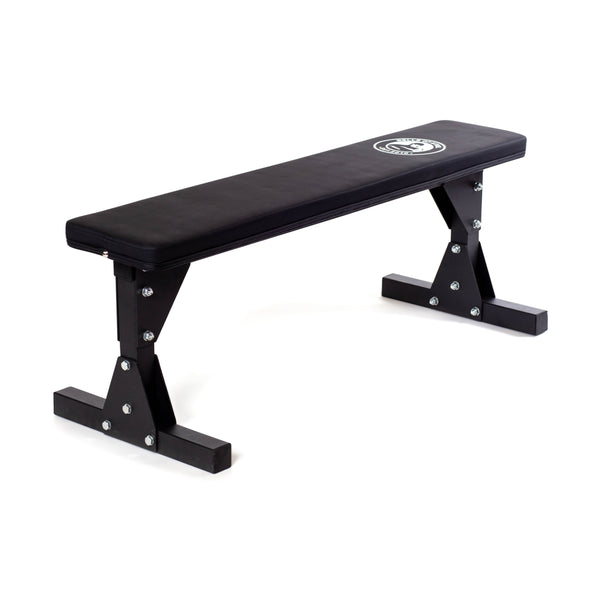
- Converter Bench — Our newest bench system. Designed to drop into a Manticore or Hydra rack as a dedicated flat pressing platform. If your incline work lives on a separate adjustable and you want a bombproof, low-profile flat setup inside your rack, the Converter is built for it.
Frequently asked questions about incline bench angles
What is the best incline bench angle for the upper chest?
30° is the best all-around incline bench angle for targeting the upper chest (clavicular fibers of the pectoralis major). It generates more upper-chest activation than flat pressing while still letting the chest — rather than the front deltoid — be the prime mover. If you pick one incline angle and stick with it, pick 30°.
Is 45° too steep for incline bench press?
45° isn't too steep — it's just a different exercise than 30°. At 45° the front deltoid takes on roughly half the load alongside the upper chest. It's a valid angle for bodybuilders and lifters who want more shoulder tie-in, but it's not a replacement for 30° if you're specifically targeting the upper chest.
What angle is an incline bench supposed to be?
An "incline bench press" traditionally refers to an angle between 15° and 45°, with 30° being the standard default. Anything steeper than 60° is effectively a seated overhead press, not an incline chest press.
Is 15° incline bench worth it?
Yes, for specific goals. 15° gives you a slight upper-chest bias while keeping the lift close to a flat bench press groove. It's most useful for powerlifters who want incline work without disrupting their competition bench, tall lifters whose shoulders hurt at steeper angles, and anyone returning from a shoulder injury who wants a gentle variation.
Should I use a barbell or dumbbells for incline press?
Both work. A barbell lets you load more weight and progress faster, which makes it the better choice for building strength and size in the upper chest. Dumbbells allow a greater range of motion and independent limb work, which is useful for hypertrophy and correcting side-to-side imbalances. Most well-rounded programs use both — barbell incline on a strength-focused day, dumbbell incline on a hypertrophy-focused day.
How do I know what angle my bench is set to?
The most reliable benches use laser-etched angle markings next to each back pad position — these are permanent and readable under load. If your bench uses stickers that peel or has no markings at all, you can measure the angle with a smartphone level app placed on the back pad. For serious training, invest in a bench with permanent angle indicators so you can replicate setups exactly.
Why does my upper chest not grow from incline pressing?
The three most common reasons are: (1) the angle is too steep and the front delt is stealing the lift — drop back to 30°, (2) you're pressing to the face instead of the upper chest — bar path should land at the top of the sternum, and (3) you're not running any single angle long enough to drive adaptation — stick with one primary incline angle for at least 8–12 weeks before rotating.
Can I do incline bench on a flat bench?
No — a flat bench doesn't adjust to an incline position. You need either an adjustable bench (often called an FID bench — flat/incline/decline) or a dedicated incline bench fixed at one angle. If you only have a flat bench and want incline work, consider upgrading to a quality adjustable bench like the Buzz-Saw.
The bottom line
For most lifters, most of the time, 30° is the best incline bench angle. It hits the upper chest harder than flat pressing without letting the shoulders take over. Use 15° for subtle variation or when shoulders are cranky, 45° as a secondary angle when you want more shoulder tie-in, and call anything 60°+ what it actually is — a seated overhead press.
More important than the exact angle: pick one primary angle, log it every session, and drive it forward for 8–12 weeks before rotating. And invest in a bench that lets you hit the same angle every session — because angle consistency is the quiet secret of incline-press progress.
→ Shop the Buzz-Saw Heavy-Duty Adjustable Bench · → Browse all Bells of Steel benches