Quick Answer
The trap bar deadlift and barbell deadlift train the same movement pattern with different emphases. The trap bar (also called a hex bar) shifts the load closer to your center of gravity, recruits more quad, and puts less shear force on your lower back — making it better for beginners, tall lifters, athletes, and anyone training around back issues. The barbell deadlift places more demand on the hip and posterior chain, and is required if you're preparing for a powerlifting meet. For most home gym lifters, the trap bar is the safer, more versatile choice.
Trap Bar and Hex Bar Are the Same Thing
Before we go any further: "trap bar" and "hex bar" are two names for the same piece of equipment. The original Al Gerard design from 1985 was trapezoidal in shape (hence "trap bar"). Modern versions are usually hexagonal, which is why you'll also see them sold as "hex bars." Same tool, same exercise, two names. Every keyword, study, and training recommendation that applies to one applies to the other.
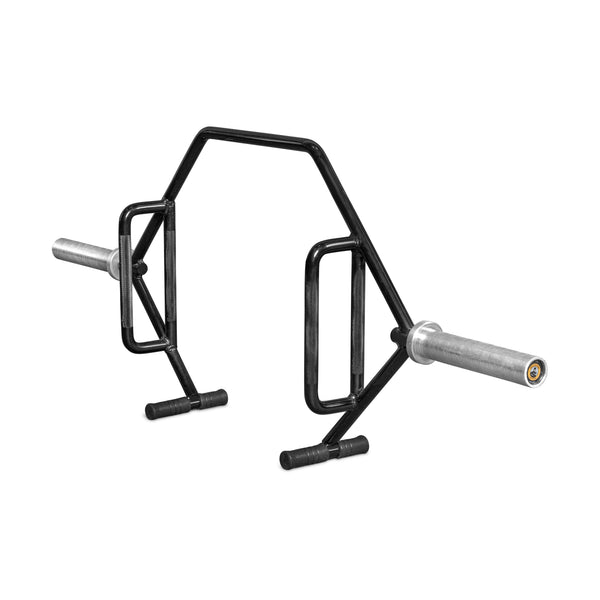
The distinction that does matter is open vs. closed frames. A closed hex/trap bar surrounds you like a cage — you step in, pull, step out. An open-ended trap bar (like the Bells of Steel Open Trap Bar) drops you in and out easily, loads like a regular barbell, and lets you perform exercises a closed frame physically can't — rows, lunges, presses, carries, and more. We'll come back to why that matters later.
Trap Bar vs Barbell Deadlift at a Glance
Here's the 30-second comparison. We'll break each row down in detail below.
| Feature | Trap Bar Deadlift | Barbell Deadlift |
|---|---|---|
| Hand position | Neutral (palms facing you) | Pronated, mixed, or hook grip |
| Load position | Centered over your midfoot | In front of your body |
| Lower-back shear force | Lower | Higher |
| Quad recruitment | High | Moderate |
| Hamstring / glute recruitment | Moderate | High |
| Learning curve | Easier — most lifters pull safely within a session or two | Harder — takes weeks to drill setup and bar path |
| Grip demand | Moderate | High — grip often fails before legs do |
| Powerlifting carryover | Indirect | Direct (meet-specific movement) |
| Best for | Most home gym lifters, athletes, beginners, tall lifters | Powerlifters, dedicated posterior chain work |
Muscles Worked: Trap Bar vs Barbell Deadlift
Both lifts are compound hip hinges that recruit most of the posterior chain. The difference is emphasis — what gets loaded hardest.
Trap Bar Deadlift Muscles Worked
- Quadriceps — the more upright torso and centered load shift work to the front of the thighs
- Glutes (gluteus maximus) — powerful hip extension at lockout
- Hamstrings — assist hip extension throughout the pull
- Spinal erectors — stabilize the torso against flexion, at lower shear load than a barbell deadlift
- Trapezius, rhomboids, rear deltoids — isometric upper-back work to keep the shoulders packed
- Forearms and grip — less demand than a barbell because the neutral grip distributes load evenly across both hands
- Core (transverse abdominis, obliques) — braces the spine through the pull
Barbell (Conventional) Deadlift Muscles Worked
- Hamstrings and glutes — the bar position in front of the body dramatically increases hip-dominant demand
- Spinal erectors — longer lever arm means more demand to prevent torso flexion
- Quadriceps — still involved, but secondary
- Lats — pulled hard to keep the bar close to the body throughout the pull
- Trapezius, rhomboids, rear deltoids
- Forearms and grip — far higher grip demand; grip is often the limiting factor
- Core
Simple rule: The trap bar trains the deadlift movement pattern with more quad and less back stress. The barbell deadlift trains it with more posterior chain, more back stress, and more grip demand. Neither is "better" — they're emphases of the same pattern.
When to Pick the Trap Bar
The trap bar is the better choice if you fit any of these profiles:
You're a beginner. The neutral grip, centered load, and shorter technical checklist make the trap bar dramatically easier to learn. New lifters often spend weeks drilling conventional deadlift setup — bar path, hip hinge, lat engagement — before they can safely pull meaningful weight. The trap bar shortens that timeline to a single session for most people. You squat down, grip, stand up.
You have back issues or a history of injury. Biomechanics research consistently shows lower peak spinal flexion moments with the trap bar versus a conventional barbell deadlift. That's not a free pass — you still need good form — but the reduced shear force is real and matters over years of training.
You're a tall lifter (6'2" and up). The conventional deadlift rewards short femurs and long arms. Tall lifters with long femurs often struggle to get into a safe setup position, especially off the floor. The trap bar's higher grip placement (particularly using the high handles) solves most of that without needing to pull from blocks.
You're training for athletic performance. Most sports don't require a specifically barbell-shaped hip hinge. They require lower-body power and force production. The trap bar deadlift shows better carryover to vertical jump, sprint speed, and general athleticism in most sport-science studies — partly because it's easier to generate peak power with the centered load.
You train alone in a home gym. No spotter, no safety cues, no second set of eyes. The trap bar's forgiving profile is a real advantage when you're training solo.
You want one tool that trains more than deadlifts. With an open trap bar specifically, you can deadlift, shrug, row, farmer's carry, lunge, and even overhead press — all with the same bar. That's hard to match with a closed frame.
When to Pick the Barbell
The barbell deadlift is the better choice if:
You're training for a powerlifting meet. USAPL, IPF, USPA, and every other major federation require a conventional or sumo barbell deadlift. The trap bar is not a substitute for meet preparation. If you're competing, the barbell is non-negotiable.
You want to maximize posterior chain development. The barbell deadlift is the gold standard for loading the hamstrings, glutes, and spinal erectors. If you want the biggest possible carryover to the squat, Olympic lifts, or any movement that depends on a strong hip hinge, the barbell deadlift is the primary tool.
Grip strength is a training priority. The barbell's straight handle with a pronated grip taxes the hands and forearms far more than the trap bar's neutral grip. If you're training for strongman, Brazilian jiu-jitsu, climbing, or anything else where grip matters, that's a real advantage of the barbell.
You're training for a test that specifies a barbell deadlift. Strongman events, some CrossFit events, and certain military and first-responder fitness tests all require a barbell deadlift. Train the movement you'll be tested on.
The pragmatic take: Most home gym lifters who aren't competing in powerlifting should run the trap bar as their primary deadlift variant and use the barbell as an accessory for posterior chain work. We'll show exactly how to program that below.
Trap Bar Deadlift Form: Step-by-Step Walkthrough
Watch the full walkthrough from the Bells of Steel team, then read through the six-point checklist below.
The Six-Point Form Checklist
1. Load the bar and step inside. Plates on both sleeves. Step into the middle of the frame with your feet roughly hip-width apart — the same stance you'd use for a vertical jump.
2. Choose your handle height. Most open trap bars have two handle heights. Use the high handles if you're a beginner, if you're tall, or if you're training the movement specifically for athletic transfer. Use the low handles if you want to maximize range of motion and train the hip hinge closer to a conventional deadlift.
3. Hinge and grip. Push your hips back, bend your knees, and reach down with a flat back until your hands meet the handles. Grip just tight enough to control the bar. Death-gripping wastes energy and adds tension that interferes with your pull.
4. Set your back and brace. Pull your shoulders down and back. Take a breath into your belly (not your chest) and brace your core like you're about to take a punch to the stomach. Your spine should be neutral — not rounded, not hyperextended.
5. Drive through the floor. Push your feet through the floor as if you're trying to leg-press the ground away from you. Stand up. Keep the bar path vertical — no swinging, no drifting forward.
6. Lock out, then reverse. At the top, squeeze your glutes and stand tall. Don't hyperextend your lower back at lockout. Reverse the movement under control — hips back first, then bend the knees once the bar passes your knees.
Common Mistakes to Avoid
- Rounding the lower back on setup. Reset and brace harder. If you can't hold a neutral spine, the weight is too heavy.
- Letting the bar drift forward. Drive through your heels, not your toes. If the bar feels like it's pulling you forward, you're starting with hips too low.
- Hyperextending at lockout. Neutral spine, squeeze glutes. Your lower back should not arch backward at the top.
- Starting with hips too low. This is a deadlift, not a squat. Think hinge, not sit. Your shoulders should start slightly in front of the handles, not stacked over them.
Programming: Trap Bar as a Primary Lift vs. an Accessory
If the Trap Bar Is Your Primary Deadlift Variant
If you're not competing in powerlifting, the trap bar deadlift can be your main deadlift. Treat it like any other primary compound — program it 1 to 2 times per week, working in the 3–8 rep range for strength, or 8–15 reps for hypertrophy. Beginners can run linear overload (add weight every session) for months. Intermediates should shift to a percentage-based plan like 5/3/1 or Texas Method adapted for the trap bar.
Sample home gym week (strength-focused intermediate, 4 days per week):
- Monday — Lower A: Trap bar deadlift 4×5 @ 80% 1RM. Back squat 3×5. Walking lunges 3×10/leg. Hanging leg raises 3×10.
- Tuesday — Upper: Bench press 4×5. Bent-over row 4×8. Overhead press 3×8. Pull-ups 3 × max.
- Thursday — Lower B: Barbell Romanian deadlift 3×8 (posterior chain accessory). Front squat 3×5. Bulgarian split squat 3×8/leg. Plank 3×45s.
- Saturday — Upper: Close-grip bench press 4×6. Chin-ups 4×6. Landmine press 3×10/side. Barbell curl 3×10.
If the Trap Bar Is an Accessory to the Barbell Deadlift
If you're training for powerlifting, the barbell deadlift stays primary. Use the trap bar as a second lower-body-day movement or as a power-development tool early in a session:
- Speed pulls: 6 sets of 3 at 50–60% of your trap bar 1RM, focused on maximal intent and bar speed. Trains rate of force development.
- Volume hypertrophy work: 3 sets of 10–12 at a moderate load. Drives size in the quads and glutes without adding fatigue to the barbell deadlift pattern.
- Trap bar jumps: 4 sets of 3 with a light-to-moderate load as a power-focused warm-up before squat or deadlift days. Wake up the nervous system.
Trap Bar Deadlift Alternatives (If You Don't Own One Yet)
Don't have a trap bar yet? Here are three movements that train a similar stimulus while you save up for one.
1. Heavy Dumbbell Suitcase Deadlift. The closest single-piece-of-equipment analog. Hold a heavy dumbbell in each hand with a neutral grip, hinge, and deadlift. Mimics the neutral grip and centered load. Limited by the heaviest dumbbells you own — most home gyms top out around 100 lb adjustable dumbbells, which is usable for hypertrophy work but caps your strength ceiling.
2. Kettlebell Deadlift (Sumo Stance). For beginners without a barbell yet. Place a heavy kettlebell between your feet in a sumo stance, hip hinge, and lift. Good for grooving the pattern at lower loads and building tissue resilience before you load heavier.
3. Safety Bar Good Morning. If you own a Safety Squat Bar, a good morning trains the hip hinge with the bar loaded on your traps. Different mechanics, same pattern — and it carries over to both the trap bar and barbell deadlift.
None of these fully replace a trap bar. But they'll maintain movement quality until you can add one to your setup.
Why the Open Trap Bar Is the Upgrade
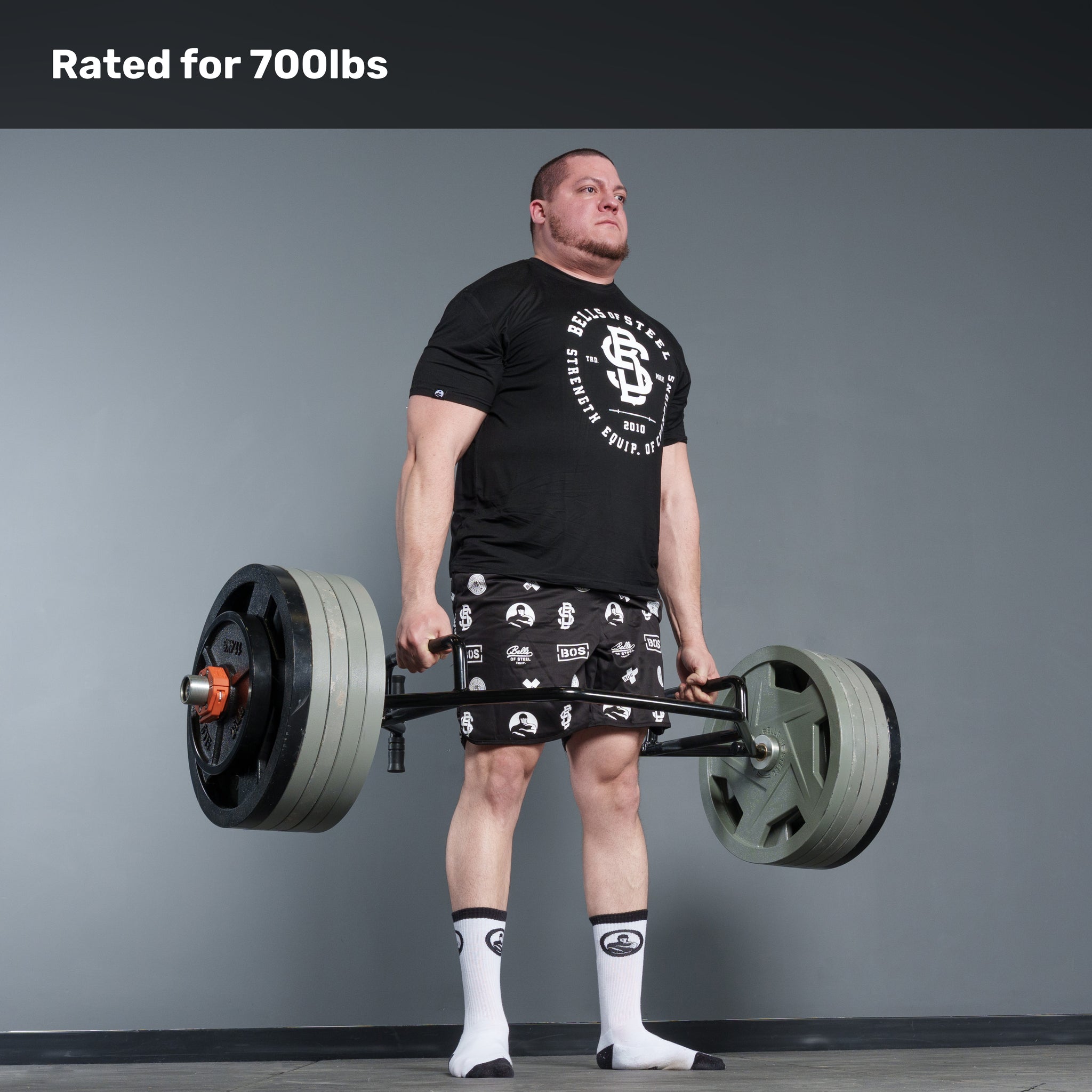
Most trap bars are closed frames — a hexagonal cage you step into and out of. That design has three practical problems:
- You can't do exercises that require the bar to move past your body — rows, presses, Romanian deadlifts with a full range of motion.
- Loading and unloading is awkward. You have to tip the bar sideways to get plates on or off.
- The closed frame limits you to essentially deadlifts, shrugs, and squats. That's it.
The Bells of Steel Open Trap Bar solves all three:
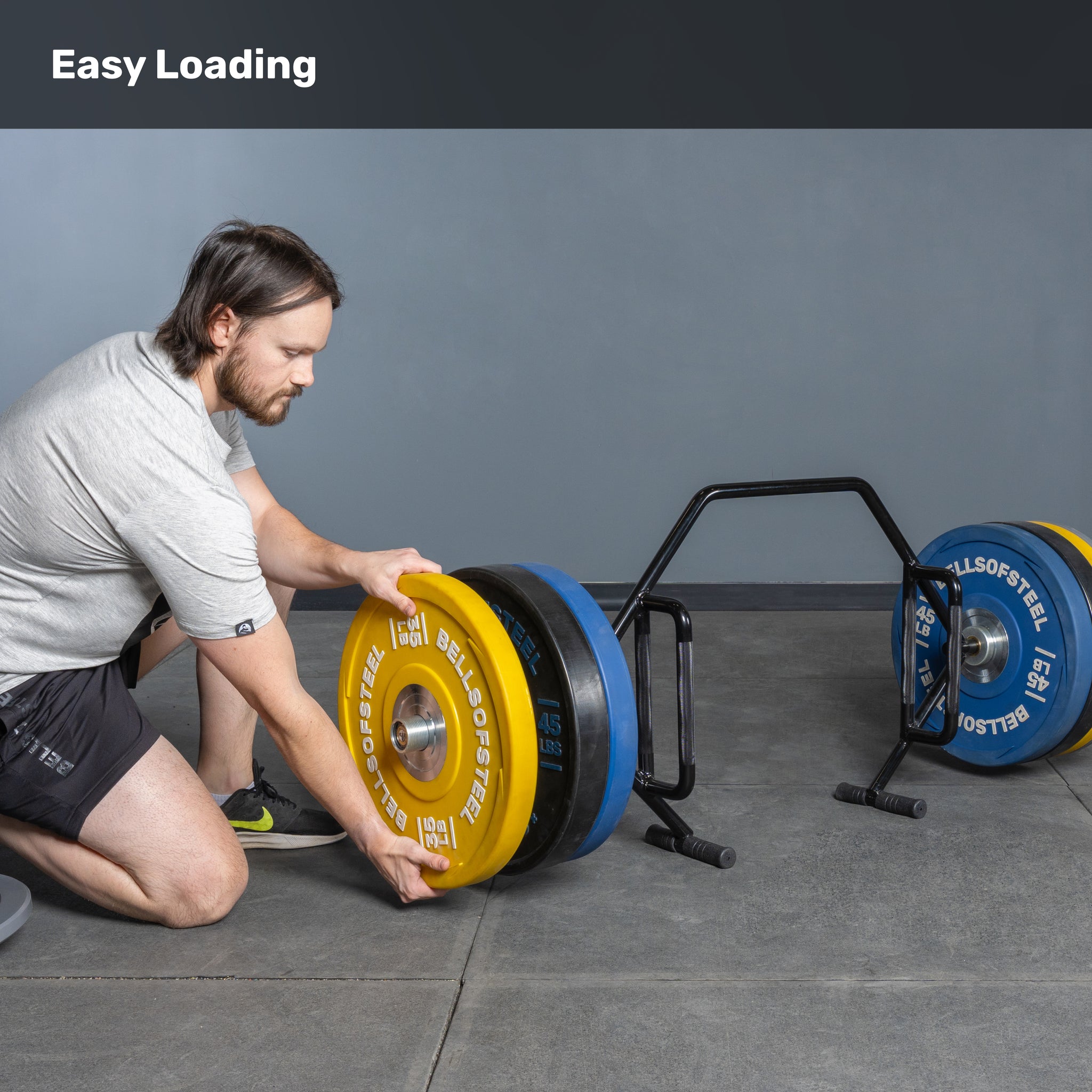
- Open ends. Plates slide on and off just like a regular barbell. No tipping, no fighting the frame. You can row, lunge, press, and carry with exercises a closed trap bar physically can't accommodate.
- Built-in deadlift jack. Rotate the bar vertically onto its built-in jack feet and your plates end up inches above the floor. Loading and unloading between sets becomes effortless — no more 45-pound plate wrestling.
- Dual handle heights. Both high and low handles built into the same bar. Tall lifters, short lifters, athletes training for power, and powerlifters working deadlift range of motion all served by one tool.
- 700 lb weight capacity, 50mm Olympic sleeves. Compatible with bumper plates, iron plates, and change plates. Rotating sleeves reduce wear and protect your wrists.
- 47 lbs / 21.3 kg bar weight. Olympic-standard weight. Fits in a home gym without needing a dedicated half-rack.
- Fully knurled handles. Secure grip without shredding your palms.
At $314.99 USD, the Open Trap Bar is priced for home gym lifters who want one specialty bar that does more than deadlifts. For most Bells of Steel customers, it's the best second barbell purchase after a standard power bar.
Related Specialty Bars for Your Home Gym
The trap bar covers the deadlift pattern. For squats and presses, two more specialty bars complete the home gym setup:
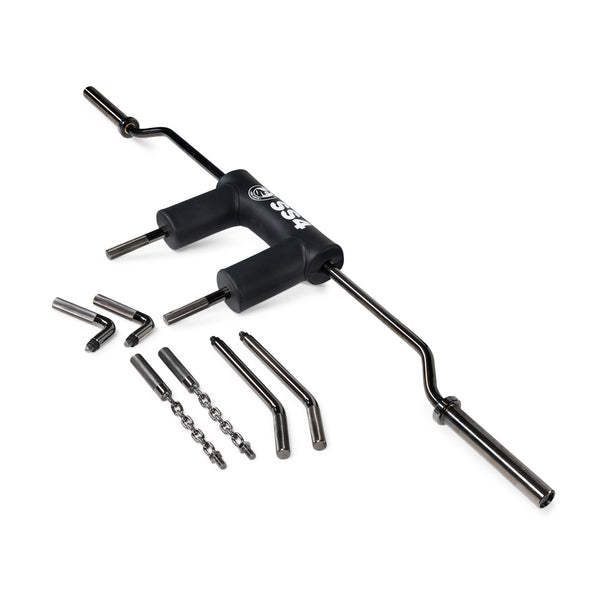
- Safety Squat Bar (SSB) — the go-to for lifters with shoulder mobility issues or anyone who wants to train heavy squats without the shoulder stress of a straight bar. The cambered design and padded yoke make it a staple in strength-focused home gyms.
- Arch Nemesis Swiss Bar — neutral-grip pressing for anyone with shoulder, elbow, or wrist issues. Also excellent for tall lifters who find the flat bench uncomfortable under heavy load.
Together, these three specialty bars handle the deadlift, squat, and press patterns without the joint cost of their straight-bar equivalents. A detailed comparison guide to all three is coming in the next installment of this series.
Want more training ideas for your trap bar specifically? See our earlier piece on 5 Open Trap Bar Exercises to Rev Up Your Leg Day.
Frequently Asked Questions
Is the trap bar deadlift better than the barbell deadlift?
Neither is universally better. The trap bar deadlift is better for beginners, tall lifters, anyone training around back issues, and athletes training for general strength and power. The barbell deadlift is better for powerlifting competition, posterior chain specificity, and grip development. Most home gym lifters should use the trap bar as their primary deadlift and the barbell as an accessory.
What muscles does the trap bar deadlift work?
The trap bar deadlift works the quadriceps, glutes, hamstrings, spinal erectors, trapezius, rhomboids, rear deltoids, forearms, and core. Compared to a barbell conventional deadlift, it emphasizes the quadriceps more and loads the lower back less.
Is the trap bar deadlift safer than the barbell deadlift?
For most lifters, yes. The centered load position reduces peak shear force on the lower back compared to a conventional barbell deadlift. That said, safety ultimately depends on form, programming, and individual biomechanics. The trap bar is forgiving, not foolproof.
Can I deadlift as much with a trap bar as with a barbell?
Most lifters pull slightly more with a trap bar than with a conventional barbell deadlift. The gap varies by individual, but the more upright torso and shorter moment arm make the trap bar mechanically easier for most people.
How much does the Bells of Steel Open Trap Bar weigh?
The Bells of Steel Open Trap Bar weighs 47 lbs (21.3 kg).
Can I squat with a trap bar?
Yes — the trap bar squat is a legitimate squat variation, particularly useful for lifters with shoulder or wrist issues who can't comfortably back-squat. It trains a similar pattern to the front squat, with a centered load and a neutral grip.
What is the weight capacity of the Bells of Steel Open Trap Bar?
The Bells of Steel Open Trap Bar has a weight capacity of 700 lbs (318 kg).
Does the trap bar deadlift still train the posterior chain?
Yes, but to a lesser extent than a conventional barbell deadlift. The trap bar shifts some of the load from the hamstrings and glutes to the quadriceps. For dedicated posterior chain work, pair trap bar deadlifts with Romanian deadlifts or good mornings.
The Bottom Line
For most home gym lifters — beginners, intermediates, athletes, and anyone training for general strength — the trap bar deadlift is the better primary deadlift variant. It's safer, easier to learn, more versatile, and trains the same movement pattern as a barbell deadlift with a different emphasis.
The barbell deadlift is still a required movement if you're competing in powerlifting, and it's a valuable tool for posterior chain specificity regardless of your goals.
If you're building a home gym and trying to pick between the two, get both if you can. If you have to pick one, start with the Open Trap Bar. You'll use it for far more than just deadlifts — and your lower back will thank you a decade from now.
Shop the Bells of Steel Open Trap Bar →