Press play and train along. The workout runs in real time, so the on-screen timer is the only timer you need. Grab a kettlebell, hit start, and let the coaching carry you through.
A full body kettlebell workout trains every major muscle group with a single bell. This beginner-friendly version uses four movements (swings, gorilla rows, goblet squats, and shoulder press) at 30 seconds of work and 30 seconds of rest, repeated for three rounds. Total time is about 20 minutes, and the only equipment required is one kettlebell. The video above runs in real time, so it can be followed along start to finish.
Most full-body sessions ask for a rack, a loaded bar, and a plate tree. This one asks for a single kettlebell and a patch of floor.
Coach Mo and Coach Alicia built this follow-along workout for people who have never touched a kettlebell before. Nothing is sped up or edited down: every rep, every countdown, and every rest period plays out at real speed, so the video can be treated as the session itself rather than a preview of it. Below you will find what a full body kettlebell workout actually is, why one bell is enough, a head-to-toe warm-up, the four movements with form cues, the full 20-minute structure, and how to pick a weight you can actually press.
What is a full-body kettlebell workout?
A full body kettlebell workout is any session that trains a hinge, a squat, a pull, and a press using one implement. Cover those four patterns and almost nothing gets left out.
Kettlebells suit this format because the weight hangs below the handle instead of sitting in line with it. That offset turns every rep into a balance problem as well as a strength problem, which is why a single moderate bell can leave you breathing hard.
Why one kettlebell is enough
Two of the four movements load one side at a time, so the trunk has to resist rotation just to keep you upright. That is work a machine hands to you for free.
The other two are two-handed and go heavy on the hips and legs. Between them, the four movements cover the posterior chain, quads, shoulders, back, and core without a single equipment change.
Four patterns, one bell, 20 minutes. The limiting factor in a beginner kettlebell workout is almost never the equipment list. It is whether the rest periods get respected.
What you need to get started
One kettlebell, light to moderate to start. That is the entire equipment list.
You also want floor space to press overhead without rearranging the ceiling fan, plus a wall to hang onto during the warm-up leg swings. Two of the four movements start with the bell against your chest, so it has to sit comfortably there and still travel overhead. The kettlebell lineup is the place to start if your current bell is fighting you.
The head-to-toe warm-up
The session opens with a joint-by-joint warm-up that runs from the neck to the ankles. Skipping it is a fast way to meet your lower back.
| Area | What to do | Reps |
|---|---|---|
| Neck | Look up and down, then side to side with shoulders away from the ears, then slow head circles | 3 each |
| Shoulders | Slow shoulder rolls forward and back, then full arm circles each way | 5 each |
| Torso | Slow twists with feet wider than hip width, then full torso circles reaching toward the floor | 3 each way |
| Hips | Leg swings front to back, then side to side, using a wall for balance | 5 per leg |
| Legs | Deep bodyweight squats with heels flat, then hip hinges with a flat back | 5 each |
| Ankles | Ankle circles both directions, then heel-to-toe rocks with the hips forward | 5 circles, 10 rocks |
A few mobility tools make that opening block more pleasant, though none of it is required.
The four kettlebell movements
Every round runs these four in the same order. Learn the cues once and the rest of the workout is just repetition.
1. Kettlebell Swing
Grab the bell with both hands and start it between your legs with a soft bend in the knees. Power comes from the hips, not the arms: push against the floor, extend the legs, and squeeze the glutes at the top while the arms stay long. Keep the shoulders back and down so the lats stay engaged. This is a Russian swing, so the bell stops at eye level rather than travelling overhead.
2. Gorilla Row
Set the bell between your feet, take a wide stance, and keep a flat back. Pull the bell up so your hand finishes in line with your hip, not toward the armpit, then lower it and switch sides. Squeeze the shoulder blades at the top and control the way down. Keep the shoulders even, because letting one drop turns the row into a twist.
3. Goblet Squat
Flip the bell upside down and rest it against your chest with the elbows pointed at the floor. Holding it by the handles works too, as long as the bell stays on the chest. Push the hips back like you are sitting into a chair, drive the knees out, and go as deep as you can with the weight on your heels. Chest stays proud and eyes stay on the horizon.
4. Single Kettlebell Shoulder Press
Hold the bell in the same position as the goblet squat, elbows in close, back flat. Drive it straight up until the arms line up with the ears and the head comes between them, then lower it slowly back in line with the chest. Exhale on the way up, inhale on the way down. Legs stay straight, and no momentum.
The full 20-minute kettlebell workout
One round takes four minutes. Three rounds plus rest lands the whole session right around 20 minutes. The table below is the same sequence the video counts down, so use it as a reference sheet once you no longer need the screen.
| Exercise | Time | Notes |
|---|---|---|
| Kettlebell Swing | 30 sec on, 30 sec off | Hips drive, arms stay long, bell stops at eye level |
| Gorilla Row | 30 sec on, 30 sec off | Alternate sides, flat back throughout |
| Goblet Squat | 30 sec on, 30 sec off | Weight on the heels, chest upright |
| Shoulder Press | 30 sec on, 30 sec off | Alternate or split the time between arms |
| Round rest | 1 minute | Stay standing, shake it out, breathe, sip water |
Repeat for three rounds. If three is too much on the first attempt, cut the round count and build up from there. Once three rounds stop feeling hard, add rounds, add reps, or add weight.
How heavy should your kettlebell be?
The shoulder press sets the ceiling for this session. A bell that presses easily but feels weightless in the goblet squat is too light, and one that stalls the press is too heavy.
- Start light to moderate. The workout is built for beginners, and the 30-second intervals make a modest bell feel heavier than expected.
- Test the press first. If you cannot finish 30 seconds of pressing with clean form, size down before the first round rather than during the third.
- Expect a gap. The weight that challenges a goblet squat is usually heavier than the one that challenges a press.
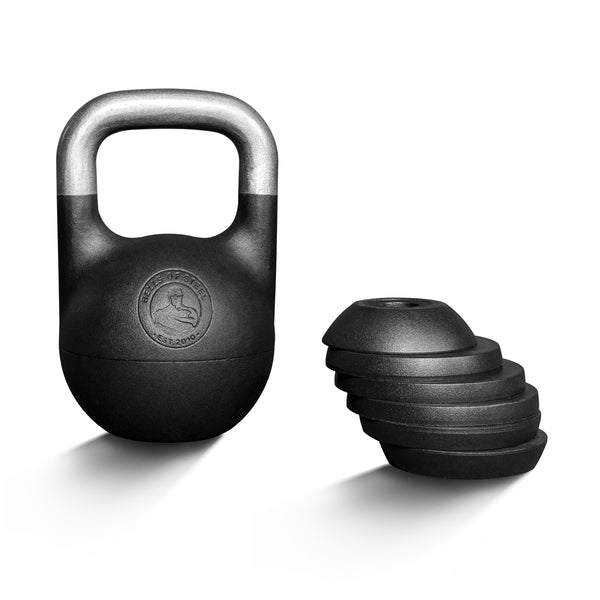
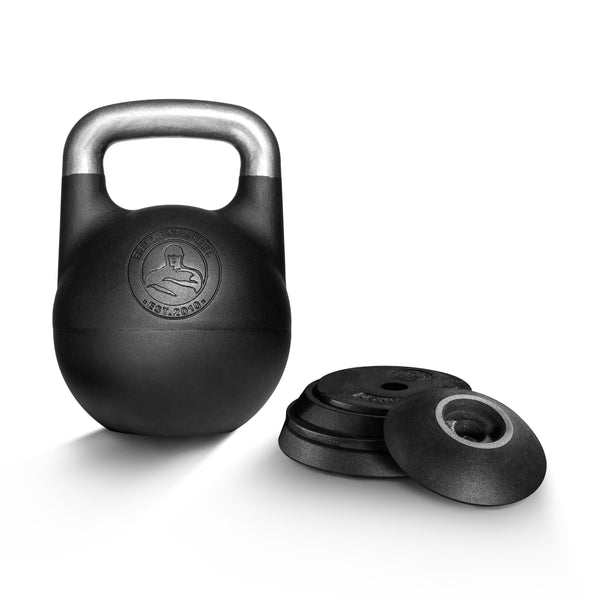
That gap is exactly why adjustable kettlebells earn their floor space: one bell covers both loads without a row of iron along the wall. If a set of fixed bells is more your style, kettlebell storage keeps them stacked instead of scattered across the garage like landmines.
Beginners often buy a single bell sized to the press, then outgrow it on squats within a few weeks. Either start with an adjustable bell or plan for a second, heavier one once three rounds stop leaving you winded.

Competition Kettlebells
Every bell is the same size no matter the weight, so the rack position and grip you learn in this workout stay identical when you move up. Available from 4 KG to 40 KG.
Shop Competition Kettlebells
Adjustable Competition Kettlebell
One bell that covers the pressing weight and the squatting weight, so the workout scales without a second purchase.
Shop Adjustable KettlebellsFull body kettlebell workout FAQ
Is this kettlebell workout good for beginners?
Yes. Every movement gets walked through with form cues before the timer starts, and the 30 seconds of rest between exercises is built in rather than optional. Cutting to one or two rounds is a normal starting point.
How long is the workout?
About 20 minutes for three rounds, including the full minute of rest between rounds. The warm-up adds roughly five minutes on top.
Can one kettlebell really train the whole body?
Four movements covering a hinge, a pull, a squat, and a press hit the posterior chain, back, legs, shoulders, and core. One bell is enough to make all four hard.
What weight kettlebell should a beginner start with?
Light to moderate, chosen by what you can press for 30 seconds with clean form. Sizing to the press keeps the hardest movement honest and leaves room to progress.
How often should this workout be done?
Two to three full-body sessions a week works well for most people, with a rest day between. Progress by adding rounds, reps, or weight once the current version stops feeling hard.
Is a timer needed for this workout?
No. The video runs in real time and counts every interval down out loud, so pressing play and following along covers the timing. The table above works as a backup once the sequence is familiar.
What is the difference between a Russian and an American swing?
A Russian swing stops at eye level. An American swing continues overhead. This workout uses the Russian version, which is easier on the shoulders and lower back while you are learning the hinge.
Still unsure which size to start with? The B.o.S. support team answers that question daily and would rather help you pick correctly than watch you guess.