Thinking about adding kettlebells to your home gym? Price out a full set and you'll get a quick reality check. Every size costs money, and every size needs a spot on the floor. Before long, a row of bells has taken over your space and a good chunk of your budget.
An adjustable kettlebell gets you out of that. One bell and a handful of plates cover the whole range.
The Adjustable Competition Kettlebell takes a different route. Below, you'll find out what sets it apart, how to swap the weight, and which size makes sense for you to start with.
Why Go Adjustable in the First Place
Think about what a full kettlebell set costs. Now think about where you'd put it. A single adjustable bell replaces the whole lineup, so you skip buying a dozen bells and keep your garage or spare room clear.
For a home gym, that trade is hard to beat. You get the range of a set in the footprint of one bell. It's compact and easy to move, which makes it a good fit for apartments and tight training corners where a full rack of bells was never going to happen.
0.5 kg Jumps Instead of 4 kg
Here's the part that matters most for progress. Fixed competition kettlebells usually step up 4 kg at a time. That's a big leap, and it's why so many lifters stall out on their lifts sooner than they'd like.
This bell's plates let you add weight in 0.5 kg steps. Small jumps keep you moving forward on most exercises instead of stalling out between sizes. Across the full range, that works out to 41 different weight settings.
The Weight Range: 12 to 32 kg
Here's how the numbers stack up:
- Empty shell: 12 kg
- With the five included plates: up to 20.5 kg, in 0.5 kg steps
- With the expansion pack: up to 32 kg
- With the optional plastic bottom: starts at 9 kg instead of 12
So one bell covers everything from 12 kg to 32 kg. Want to start lighter? Swap in the plastic bottom and drop the empty weight to 9 kg. Outgrow 20.5 kg? Add the 12-32 KG Expansion Pack and keep climbing without buying a second bell.
A Two-Nut System Keeps the Weight Centered
Plate-loaded doesn't have to mean lopsided. The bell uses two nuts to clamp the plates in the middle, so the load stays evenly spread whether you've added one plate or all of them.
That balance is the whole point. It makes the bell feel like a fixed competition kettlebell at any weight. Dial-style designs often can't say the same, and some end up unbalanced or top-heavy.
Steel Shell and Iron Plates
The shell is steel and the plates are iron. No plastic dials, no fragile parts. You can set it down hard on concrete and it'll shrug it off.
Plenty of adjustable bells use plastic so you can change weights faster. The trade-off is durability, and those bells tend to wear out sooner. One note if you add the plastic bottom: it's the exception to the tough-as-nails rule, and its warranty is void if you drop it.
Same Size and Feel as a Competition Kettlebell
Put this bell next to a fixed competition kettlebell and you'll see they match. The window is the same size, and both handles measure 35 mm across.
The match carries over to how it moves, too. It sits in the front rack the same way, and it stays balanced when you press it overhead. If you train with competition bells, you won't need to relearn anything.
How to Change the Weight
Every new bell ships with the tools you need. The process goes like this:
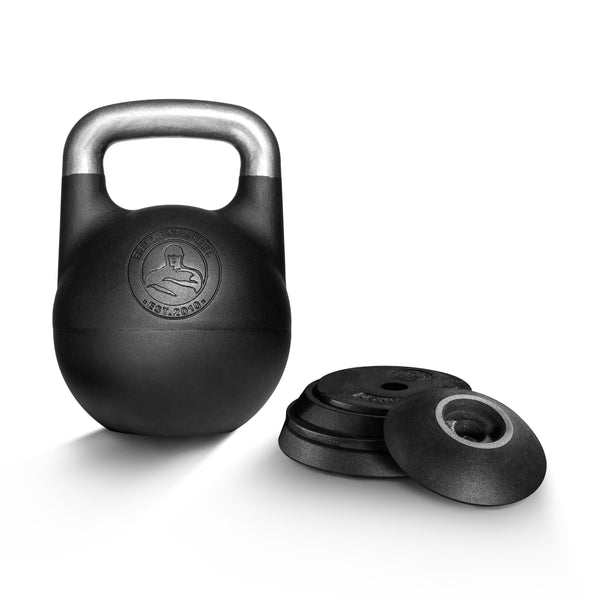
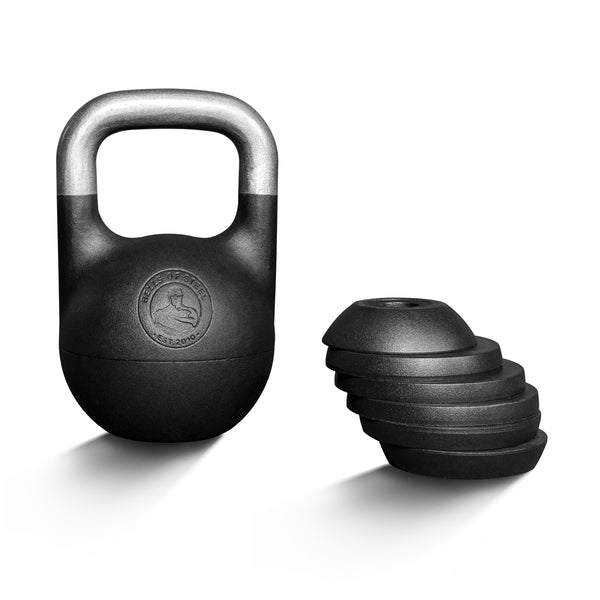
- Use the Allen key & wrench to take the shell off.
- Remove the nut.
- Load the plates you want.
- Put the nut back on and use the tools to snug it tight.
- Refit the shell and finish with the second tool.
Expect each change to take 1 to 2 minutes. That's fine between sessions, but it's slow if your workout jumps between weights. Need one weight for swings and another for overhead work? Grab a pair instead. Buying two saves you 10%.
Which Weight to Start With
If you're new to kettlebells, the 12-20.5 kg version is a solid place to start. It gives you plenty of room to learn the basics and build up. When you're ready for more, add the expansion pack and work your way to 32 kg.
Is 12 kg still too much on day one? No problem, you've got two lighter options. Swap in the plastic bottom to drop the starting weight to 9 kg.
Or start with the 6-12 KG Adjustable Kettlebell and build your strength and confidence there first. Once you're ready, the 12-32 kg bell takes over and keeps you progressing for the long haul.
Also, adding plates isn't your only way to get stronger. You can:
- Add more reps
- Slow down the tempo
- Move to a harder version of the exercise
Mix those in and you'll keep progressing long before you need the next plate.
Buy It Once
The best adjustable kettlebell is the one you'll never need to replace.
With fixed bells, that means another purchase every time you outgrow one. The expansion pack takes you from 20.5 kg to 32 kg on the same shell you already own.
It works in the other direction, too. If 12 kg is more than you need right now, the plastic bottom brings the starting weight down to 9 kg. The bell meets you where you are on day one and keeps up as you get stronger.
If that sounds like the kettlebell setup you've been trying to piece together, check out the full lineup below.